Option: 4 is correct
Explanation:
Acceleration is constant all throughout the free fall.
- An object that is moving only because of the action of gravity is said to be free-falling and its motion is described by Newton's second law of motion.
- Newton's second law of motion states that the net force acting on an object is equal to its mass multiplied by its acceleration
Option: 1 is correct
Explanation:
- Option 1: Magnetic field lines produced by the same source never intersect. Field lines represent the direction of the magnetic field at any point, and intersecting lines would imply two possible directions at a single point, which is not possible.
- Option 2: Field lines can originate from the same point if the source is like a magnetic pole, as lines emanate outwards.
- Option 3: Field lines can terminate at the same point in the case of a magnetic sink, like another magnetic pole.
- Option 4: Field lines do not intersect, regardless of the situation, since this would contradict the fundamental properties of vector fields.
Option: 1 is correct
Explanation:
Fleming's rules has nothing to do with magnetic field
Option: 2 is correct
Explanation:
All the simple harmonic motions are necessarily periodic motions
Option: 3 is correct
Explanation:
- Option 1: Raman effect
- Related to the scattering of light.
- Used for studying vibrational and rotational phenomena in molecules.
- Option 2: Induction effect
- Involves inducing electric current in a conductor due to a changing magnetic field.
- Not used in speed detection by radar.
- Option 3: Doppler effect
- Correct answer for radar speed detection.
- Measures change in frequency of waves to determine speed.
- Widely used in police radar to detect speed by analyzing frequency shifts.
- Option 4: Coulomb effect
- Involves forces between charged particles.
- Not relevant to radar speed measurements.
Option: 3 is correct
Explanation:
There is a cause-effect relation implied in the third law
Option: 1 is correct
Explanation:
fireworks to make a bright white light
Option: 3 is correct
Explanation:
Thiourea (accelerator)
Option: 4 is correct
Explanation:
Red colour of gemstone Ruby is due to the element beryllium present in it
Option: 4 is correct
Explanation:
- Option 1: Helium
- When electricity flows through helium, it emits a pale lavender or pinkish light.
- Not typically associated with producing a red glow.
- Option 2: Argon
- Argon emits a violet or pale lavender-blue light.
- Commonly used in fluorescent lighting and signs, but not for red light.
- Option 3: Nitrogen
- Emits a blue or purplish light.
- Often used in some types of lasers but not known for red light emission.
- Option 4: Neon
- Neon produces a bright red-orange light when electricity is passed through it.
- Widely used in advertising signs for its distinctive warm glow.
Your Answer: Option 4 - Neon
Option: 2 is correct
Explanation:
- Boiling: This method is effective for temporary hardness but does not remove permanent hardness, which is caused by dissolved calcium and magnesium salts.
- Ion-exchange: This is a highly effective method for removing permanent hardness from water. It works by exchanging calcium and magnesium ions with sodium or potassium ions, thus softening the water.
-
- Lime treatment: It is effective primarily for removing temporary hardness. It works by precipitating calcium carbonate and magnesium hydroxide but is not commonly used for permanent hardness.
- Bubbling sulphur dioxide gas: This method is not usually used for removing permanent hardness from water. It's not effective for this purpose.
Thus, the ion-exchange method is indeed the correct option for removing permanent hardness.
Option: 3 is correct
Explanation:
Polyaromatic hydrocarbons.
- Photochemical smog is a brownish-gray haze caused by the action of solar ultraviolet radiation on atmosphere polluted with hydrocarbons and oxides of nitrogen.
- It contains anthropogenic air pollutants, mainly ozone, nitric acid, and organic compounds, which are trapped near the ground by temperature inversion.
Option: 2 is correct
Explanation:
DNA and Protein.
- Chromatin is a complex of DNA, protein, and RNA found in eukaryotic cells.
- Its primary function is packaging long DNA molecules into more compact, denser structures.
Option: 2 is correct
Explanation:
Platyhelminthes.
- The phylum that shows bilateral symmetry and lacking a true coelom is Platyhelminthes.
- Bilateral symmetry means when one organism is cut, it divides into two equal halves from a single plane only.
- Platyhelminthes do not have a body cavity ,that is they do not have a coelom and are acoelomates.
Option: 3 is correct
Explanation:
Alveoli.
- Tiny air sacs at the end of the bronchioles (tiny branches of air tubes in the lungs).
- The alveoli are where the lungs and the blood exchange oxygen and carbon dioxide during the process of breathing in and breathing out.
Option: 1 is correct
Explanation:
Adrenaline.
- Adrenaline (epinephrine) is a hormone your adrenal glands make to help you prepare for stressful or dangerous situations.
- Adrenaline rush is the name for the quick release of adrenaline into your bloodstream.
- This gets your body ready for a “fight or flight” response.
Option: 4 is correct
Explanation:
axon of nerve cell
- Axon, portion of a nerve cell (neuron) that carries nerve impulses away from the cell body.
- A neuron typically has one axon that connects it with other neurons or with muscle or gland cells.
- Some axons may be quite long, reaching, for example, from the spinal cord down to a toe.
Option: 1 is correct
Explanation:
Clotting of blood.
- Their primary function is to prevent and stop bleeding.
- If a blood vessel is damaged, the body sends signals to platelets which cause them to travel to the injured area.
- Once the platelets arrive at the site, they clump together to form a clot that helps stop bleeding.
Option: 1 is correct
Explanation:
linear momentum.
- Linear momentum (momentum for brevity) is defined as the product of a system's mass multiplied by its velocity.
- In symbols, linear momentum p is defined to be p = mv, where m is the mass of the system and v is its velocity.
- The SI unit for momentum is kg · m/s.
Option: 4 is correct
Explanation:
surface tension.
- Surface tension is defined as force per unit length acting perpendicular to the tangential line on the surface.
- It is due to imbalanced attractive forces acting downwards and tends to reduce the surface area of a liquid to minimum.
Option: 4 is correct
Explanation:
1, 2 and 3.
- At the triple point, the substance exists in all three phases simultaneously: liquid, solid, and vapor.
- This unique point occurs at a specific temperature and pressure where the substance can coexist as a solid, liquid, and vapor in equilibrium.
Option: 1 is correct
Explanation:
- Option 1: Temperature only
Latent heat refers to the heat absorbed or released during a phase change at a constant temperature.
- Option 2: Volume only
Latent heat is not solely concerned with the constant volume. Phase changes can happen at constant pressure or temperature.
- Option 3: Pressure only
While pressure may remain constant during a phase change, latent heat specifically involves constant temperature.
- Option 4: Temperature, volume, and pressure
This is not accurate, as latent heat emphasizes the constant temperature aspect during phase change, without necessitating constant volume or pressure.
Option: 3 is correct
Explanation:
At a frequency v > vo, the kinetic energy of ejected electrons does not change on increasing the fre quency of incident light
Option: 2 is correct
Explanation:
- Chlorine has two main isotopes: Chlorine-35 and Chlorine-37.
- Chlorine-35 makes up about 75.77%, while Chlorine-37 contributes around 24.23% to the natural abundance of chlorine.
- The average atomic mass takes into account these isotopes and their abundances.
- Correct Answer: Option 2, 35.5 u
- This is a weighted average calculation, reflecting common chlorine isotopes in nature.
Option: 1 is correct
Explanation:
- Tropolone: This compound is not a heterocyclic aromatic compound. It lacks a heteroatom in its ring, which is necessary for a compound to be classified as heterocyclic.
- Furan: It is an aromatic compound with a five-membered ring that includes an oxygen atom, qualifying it as heterocyclic.
- Thiophene: This compound has a similar structure to benzene but contains a sulfur atom in its ring, making it a heterocyclic aromatic compound.
- Pyridine: It is a six-membered aromatic ring with a nitrogen atom, making it a heterocyclic aromatic compound.
Option: 4 is correct
Explanation:
- Feldspar:
- A common group of silicate minerals.
- Forms about 41% of the Earth's continental crust.
- Zeolite:
- A group of silicate minerals often used in water purification.
- Their porous structure makes them useful as filters.
- Mica:
- A silicate mineral known for its layered formation.
- Used in electrical applications due to its insulating properties.
- Bauxite:
- Not a silicate mineral.
- Primarily composed of aluminum oxides and hydroxides.
- Main ore for aluminum production.
- Bauxite is not a silicate.
.
Option: 3 is correct
Explanation:
- Glucose is converted into pyruvate through a process called glycolysis.
- Cytoplasm is where glycolysis occurs. This is the liquid portion of the cell where various metabolic pathways take place.
- Mitochondria are the powerhouse of the cell and are involved in energy production, specifically the Krebs cycle and oxidative phosphorylation, not glycolysis.
- The nucleus contains genetic material and is not directly involved in glycolysis or energy production.
- The endoplasmic reticulum is involved in protein synthesis, lipid metabolism, and other processes, but not glycolysis.
Cytoplasm is the correct answer.
Option: 1 is correct
Explanation:
seed and fruit respectively
Option: 3 is correct
Explanation:
Glucose breaks. down into CO2, H2O and energy in all aerobic tissues
Option: 2 is correct
Explanation:
- Crop rotation: This involves growing different types of crops in the same field across different seasons or years to maintain soil health and reduce pest buildup.
- Inter cropping: This is the cultivation of two or more crops in the same field with each crop in separate rows. It maximizes space and can enhance biomass and yield.
- Alternate cropping: This is the growing of alternative crops to diversify production but not necessarily providing spatial separation like in intercropping.
- Kharif cropping: This refers to crops that are sown with the onset of the monsoon and harvested in autumn in South Asia. It is a seasonal term, unrelated to the technique of growing crops in different rows.
Option: 1 is correct
Explanation:
- Option 1: Sania Mirza
- Correct!
- Sania Mirza won the Fed Cup Heart Award in 2020.
- The award recognized her comeback to the sport after maternity leave.
- Option 2: P V Sindhu
- PV Sindhu is a prominent Indian badminton player.
- She has not won the Fed Cup Heart Award.
- Option 3: Saina Nehwal
- Saina Nehwal is another acclaimed Indian badminton player.
- She was not associated with the Fed Cup Heart Award in 2020.
- Option 4: Hima Das
- Hima Das is an Indian sprinter.
- She is not linked to the Fed Cup, which is related to tennis.
Option: 3 is correct
Explanation:
11 May.
- National Technology Day aims to celebrate all of India's achievements in tech so as to encourage more youngsters to work for the country's scientific progress.
- On May 11, the government also announces the winners of the Rashtriya Vigyan Purashkar, or the National Science Awards.
- May 11 marks National Technology Day in India, in remembrance of the groundbreaking Pokhran nuclear tests carried out by the Indian Army in 1998.
Option: 1 is correct
Explanation:
- INS Kesari:
- This was the ship deployed in 'Mission Sagar'.
- It carried food and COVID-related medical supplies to various countries.
- Mission Sagar was part of India's outreach to deliver essential aid during the pandemic.
- INS Satpura:
- It is a Shivalik-class stealth multirole frigate of the Indian Navy.
- Not specifically linked to 'Mission Sagar'.
- INS Shivalik:
- It is the lead ship of her class of stealth multirole frigates in the Indian Navy.
- Not directly involved in 'Mission Sagar'.
- INS Gomati:
- It is a Godavari-class guided-missile frigate.
- Not associated with 'Mission Sagar'.
Option: 2 is correct
Explanation:
- Goods and Services Tax (GST): GST is a comprehensive indirect tax introduced to unify the taxation system in India. It is a crucial revenue source that combines multiple indirect taxes.
- Corporation Tax: This tax is levied on the income of companies in India. It is typically a significant component of government revenue.
- Customs: This tax is imposed on goods imported into the country. While important, it generally contributes less than direct taxes to total revenue.
- Union Excise Duties: These are taxes on the production of goods within the country. They were major before GST but have declined in relative importance.
Corporation Tax generally contributed significantly to the Gross Tax Revenue in 2019-20 (BE).
Option: 4 is correct
Explanation:
Micro, Small and Medium Enterprises
Option: 3 is correct
Explanation:
- The World Economic Forum's Global Energy Transition Index assesses how well countries are transitioning to sustainable energy systems.
- Option 1: China - A leading global energy consumer and producer focusing on clean energy investments, but often challenges arise due to its extensive coal usage.
- Option 2: Switzerland - Known for its environmental policies and high energy efficiency but not currently at the top.
- Option 3: Sweden - Consistently ranks high in sustainability efforts and energy transition, leveraging renewable energy extensively. Correct Answer
- Option 4: India - While making significant strides in renewable energy, it still faces challenges compared to the highest-ranking countries.
.
Option: 1 is correct
Explanation:
- Option 1: Indian Army
- Operation Sadbhavna is a welfare initiative by the Indian Army.
- It aims to win the hearts and minds of people in conflict regions, primarily in Jammu and Kashmir.
- The initiative focuses on education, healthcare, and women empowerment.
- Option 2: Indian Navy
- The Indian Navy is not associated with Operation Sadbhavna.
- The Navy typically focuses on maritime operations and naval exercises.
- Option 3: Indian Air Force
- The Air Force primarily engages in aerial defense and air support operations.
- It is not involved in Operation Sadbhavna.
- Option 4: Indian Army and UN Peacekeeping Mission
- While the Indian Army participates in UN Peacekeeping Missions, Operation Sadbhavna is not a part of these missions.
Option 1: Indian Army
Option: 3 is correct
Explanation:
- The rank of Wing Commander in the Indian Air Force is equivalent to certain ranks in both the Indian Army and the Indian Navy.
- In the Indian Army, it corresponds to the rank of Lieutenant Colonel.
- A Lieutenant in the Indian Army is a junior officer, several ranks below a Wing Commander.
- A Captain in the Indian Army is also a junior rank and below the rank of Lieutenant Colonel.
- A Colonel in the Indian Army is senior to a Lieutenant Colonel.
Hence, the equivalent rank of a Wing Commander in the Indian Army is a Lieutenant Colonel.
Option: 3 is correct
Explanation:
I0 per cent.
- The minimum reduction in projected demand for conventional energy at the end of five years as per the 'development of solar cities' programme is 10%.
- Ministry of New and Renewable Energy (MNRE) had launched a program on “Development of Solar Cities”.
Option: 2 is correct
Explanation:
- Cyclone names in the North Indian Ocean region are suggested by countries part of the World Meteorological Organization (WMO)/United Nations Economic and Social Commission for Asia and the Pacific (ESCAP) panel.
- Option 1: Bangladesh - Bangladesh is a member of the panel but did not suggest the name 'Amphan'.
- Option 2: Thailand - Thailand suggested the name 'Amphan'.
- Option 3: Maldives - The Maldives is a member but did not suggest 'Amphan'.
- Option 4: India - India is part of the panel but was not the source of the name 'Amphan'.
Option 2: Thailand is the correct answer. Hence, .
Option: 1 is correct
Explanation:
subtracting the death rate from the birth rate
Option: 1 is correct
Explanation:
Sand spit.
- A sand spit is a long, narrow, dynamic landform of sand or gravel that's attached to the land at one end and extends into open water at the other.
- Sand spits are created by longshore drift, which moves sediment along the coast, and are often found where the shoreline changes direction, such as at river mouths, the ends of barrier islands, and inlets.
Option: 4 is correct
Explanation:
They protect communities from earthquakes.
- Vertical tectonic displacement of coral reefs associated with an earthquake.
- The coseismic vertical motion may cause submergence or raise the shallow part of reefs to levels relative to sea level above where they can live.
- The amount of vertical motion may be barely detectable or can exceed 10 m.Subsidence is less obvious than uplift, but both provide significant information regarding earthquakes and tectonic processes.
- There is no scientific evidence that They protect communities from earthquakes.
Option: 4 is correct
Explanation:
1,2 and 3.
- Acacia genus has about 160 species of trees and shrubs in the pea family.
- They have a long shallow root system that enables them to find moisture.
- It has thorny leaves to prevent water loss.
- It has a wide crown so the foliage can absorb the maximum Sunlight.
Option: 1 is correct
Explanation:
lndo European
- Dardic languages are a subgroup of Indo-Aryan languages, which are part of the Indo-European language family.
- The Indo-European language family is one of the largest in the world.
- Dardic languages are spoken in parts of northern Pakistan, northwestern India, and northeastern Afghanistan.
Option: 2 is correct
Explanation:
Domestic workers.
- The 2011 Census of India divided the working population into four categories:
- Cultivators: Farmers who manage the land they own or rent
- Agricultural laborers: Workers who work on other people's farms on a daily basis
- Workers in household industries: Includes weavers, potters, and product repairers
- Other workers: Includes factory workers
Option: 2 is correct
Explanation:
1 and 2 only.
- For the 25-29 age group, the percentage share of unemployed rural females rose to 25.41 per cent in 2017-18 from 22.6 per cent in 2004-05.
- In the 15-19 age group, the percentage share of unemployed rural females saw a reduction to 12.7 per cent in 2017-18 from 18 per cent in 2004-05
Option: 1 is correct
Explanation:
1.33
- given:
- Earlier price = Rs. 12
- New Price = Rs. 15
- Earlier demand = 30
- New demand = 20
- Formula used:Price elasticity of demand = Percentage change in quantity demand/Percentage change in price
- Calculation:Percentage change in quality demand = [(20 – 30)/30] × 100
- ⇒ [-10/30] × 100
- ⇒ -100/3%
- Percentage change in price = [(15 – 12)/12] × 100
- ⇒ [3/12] × 100⇒ 25%Price elasticity of demand = (-100/3) ÷ 25⇒ -4/3%⇒ -1.33%
- ∴ The price elasticity of demand for samosa by Kumar is 1.33%
Option: 4 is correct
Explanation:
- Wheat (1): Included in food inflation estimates. It's a staple food grain in India.
- Paddy (2): Also included, as it's a primary source of rice, a significant part of the Indian diet.
- Tobacco (3): Not included in food inflation, as it is not a food product.
- Sugar (4): Included, since it's a common food item used widely in the Indian diet.
Considering these points, the correct option is:
- Option 4: 1, 2, and 4
Option: 4 is correct
Explanation:
- During the first phase of the Green Revolution (1966-72) in India, high yielding varieties of food grains, particularly wheat and rice, were introduced.
- Punjab and Haryana were the primary states where these high yielding varieties were implemented.
- These regions were chosen due to their supportive infrastructure, irrigation facilities, and cooperative farming practices.
- Though Andhra Pradesh and Tamil Nadu also adopted elements of agricultural improvements, they were not the primary focus during the first phase of the Green Revolution.
The correct answer is Option 4: 3 and 4 only.
Option: 2 is correct
Explanation:
- Steatite seal:
- These are one of the most distinctive artefacts of the Harappan Civilisation.
- They often feature animals and script, providing insight into trade and communication.
- Bricks of a standardised ratio:
- Harappans used bricks with a uniform ratio.
- This reflects advanced town planning and construction techniques.
- Gold bangles:
- While Harappans used gold, bangles are not particularly distinctive to this civilisation.
- Silver spittoon:
- Silver objects are found, but spittoons are not uniquely representative of Harappan culture.
Correct Answer: Option 2, 1 and 2 only
Option: 4 is correct
Explanation:
- The pre-Mauryan period was characterized by the emergence of several powerful kingdoms known as the mahajanapadas.
- Kuru: Located in modern-day Haryana and Delhi, it was one of the prominent mahajanapadas known for its influence.
- Vatsa: This mahajanapada was situated around present-day Allahabad and was known for its economic prosperity and cultural significance.
- Gandhara: Located in the northwest region, parts of modern-day Pakistan and Afghanistan, it played a key role in trade and cultural exchanges.
- Kalinga: Known for being a powerful region, it was located in modern Odisha but is not traditionally listed among the sixteen mahajanapadas.
Your choice aligns with the historical list of mahajanapadas:
Option: 3 is correct
Explanation:
- Studying the Vedas: According to Dharmashastras, studying the Vedas is a duty of all the "twice-born" classes, which include Brahmins, Kshatriyas, and Vaishyas. So, Vaishyas are indeed prescribed to study the Vedas.
- Engaging in trade: Engaging in agricultural work, cattle rearing and trade is traditionally considered a duty of Vaishyas. They are expected to contribute to economic activity, making this a prescribed duty.
- Option 1 (1 only): This would mean Vaishyas are only supposed to study the Vedas.
- Option 2 (2 only): This implies Vaishyas are meant to only engage in trade.
- Option 3 (Both 1 and 2): This correctly identifies both duties as applicable to Vaishyas.
- Option 4 (Neither 1 nor 2): This is incorrect as both activities are relevant.
Option: 1 is correct
Explanation:
- The Satavahanas were indeed a significant dynasty that ruled over parts of western India and the Deccan region.
- However, it was the Shaka ruler Rudradaman I, not the Satavahanas, who is credited with repairing and rebuilding the Sudarshana Lake.
Correct Option: Option 1 - 1 only
.
Option: 4 is correct
Explanation:
They may not be used for deter mining constitutionality of laws
Option: 1 is correct
Explanation:
- Statement 1: The Governor cannot generally exercise discretionary power just because he/she is not convinced by the Council of Ministers. The Constitution expects the Governor to act on their advice, except in rare situations.
- Statement 2: The Constitution does require the Governor to act in his/her discretion in certain matters (e.g., reservation of a bill for the President, appointment of the Chief Minister when no party has a majority).
- Statement 3: If the Governor is appointed as the administrator of an adjoining Union Territory, he/she can act at his/her discretion regarding that territory.
Option 2 (1 and 2 only)
Option 3 (2 and 3 only)
Option 4 (3 only)
So, the correct answer is Option 3: 2 and 3 only.
Option: 2 is correct
Explanation:
It emphasises the centrality of community
Option: 1 is correct
Explanation:
A B C D
4 3 2 1
Option: 1 is correct
Explanation:
Airport Authority of India
Option: 3 is correct
Explanation:
Mean Years of Schooling
Option: 2 is correct
Explanation:
Market/Price Mechanism.
- When there are a lot of apple suppliers in an economy, the price of apples will be lower.
- These circumstances will see suppliers withdraw from the market over time.
- This is the invisible hand that pulls them out of the economy.
Option: 4 is correct
Explanation:
- Administered Price: Prices set by a governing authority rather than the market. These are fixed to control essential goods and ensure they are affordable for consumers.
- Market Price: The price determined by supply and demand without any intervention. It fluctuates based on changes in the market conditions.
- Control Price: Prices which are regulated and controlled by the government to stabilize the economy. It can include price ceilings or floors.
- Support Price: Prices fixed by the government to protect farmers against any sharp fall in market prices, ensuring they receive a minimum profit for their produce. It acts as a safety net.
Correct Answer: 4. Support Price
Option: 3 is correct
Explanation:
Oligopoly.
- An oligopoly is when a few companies exert significant control over a given market.
- Together, these companies may control prices by colluding with each other, ultimately providing uncompetitive prices in the market.
Option: 2 is correct
Explanation:
- Agriculture and allied sector: This sector can contribute to NPAs, but historically, the impact is not as significant as others.
- Industrial sector: Often sees large loans, and thus has a higher risk of turning into NPAs. Economic downturns can heavily affect this sector.
- Infrastructure sector: Known for large-scale projects with long gestation periods, making it prone to delays and financial strain, leading to NPAs.
- Information technology sector: Generally less associated with high NPAs due to its relatively fast returns and global demand.
Option:1 – Includes agriculture, which is not a major recent contributor.
Option:2 – Includes industrial and infrastructure sectors, both significant contributors.
Option:3 – Includes sectors with generally low NPA impact.
Option:4 – All sectors included, but IT is less relevant here.
Option: 1 is correct
Explanation:
- Wavelength: The distance between two successive crests or troughs of sea waves. This measures the length of one complete wave cycle.
- Correct Answer
- Wave height: The vertical distance between the crest and the trough of a wave. It reflects the wave's amplitude or energy.
- Wave frequency: The number of waves passing a fixed point in a given period. It indicates how often waves occur over time.
- Fetch: The distance over which the wind blows continuously over open water, influencing wave size and energy.
Option: 3 is correct
Explanation:
- Tunisia: Located in North Africa, Tunisia borders the Mediterranean Sea along its northern and eastern coasts, making it a Mediterranean country.
- Libya: Also situated in North Africa, Libya has an extensive coastline along the Mediterranean Sea to the north, qualifying it as a Mediterranean country.
- North Sudan: North Sudan, or simply Sudan, is located in northeastern Africa. It does not have a coast on the Mediterranean Sea. Hence, it is not a Mediterranean country.
- Egypt: With a northern coastline along the Mediterranean Sea, Egypt is unquestionably a Mediterranean country, lying in the northeast corner of Africa.
North Sudan is NOT a Mediterranean country.
Option: 1 is correct
Explanation:
- Option 1: LPG consumers
- PAHAL (Pratyaksh Hanstantrit Labh) scheme was launched to directly transfer LPG subsidy amounts to the bank accounts of consumers.
- This initiative ensures that subsidies reach eligible beneficiaries quickly and minimizes leakages.
- Option 2: Internet consumers
- This is not related to any government subsidy transfer initiative for internet bills or services.
- Option 3: Farmers for fertilisers
- While there are subsidy initiatives related to fertilizers, PAHAL specifically addresses LPG subsidies, not fertilizer subsidies.
- Option 4: Central Government Employees for medical treatment
- There are provisions for medical reimbursement for government employees, but PAHAL does not pertain to this.
Correct Answer:
- Option 1: LPG consumers
Option: 1 is correct
Explanation:
- Polje (Option 1):
- Largest of the karst landforms mentioned.
- Large, flat-floored depressions.
- Surrounded by steep limestone walls.
- Formed by solutional weathering and subsidence.
- Uvala (Option 2):
- Large closed depression in karst areas.
- Formed by the merging of multiple smaller sinkholes.
- Smaller than poljes.
- Swallow Hole (Option 3):
- Also known as a ponor.
- A site where a surface stream or lake drains into the ground.
- Significantly smaller than poljes and uvalas.
- Sink Hole (Option 4):
- Circular depressions in the ground.
- Created by the collapse of a subterranean void.
- Typically smaller than uvalas.
Option: 3 is correct
Explanation:
it is on main sea route where ships use to anchor for refueling, water ing and taking food items.
- It explains that Singapore is known as Port of Call because it is located on the main sea route where ships anchor for essential activities such as refueling, watering, and obtaining food items.
- As the volume of its maritime trade increased in the 19th century, Singapore became a key port of call for sailing and steam vessels in their passage along Asian sea routes.
Option: 1 is correct
Explanation:
A leave of the House is required to move it.
- A censure motion can be moved in the parliament or in a state assembly in India.
- It is moved by the opposition against a specific policy of the government or against a minister or against the whole council of ministers.
Option: 4 is correct
Explanation:
It can be referred to a joint com mittee of the two Houses
Option: 4 is correct
Explanation:
- Statement 1 suggests supplementing equal treatment with the principle of proportionality. This means fairness may require different treatment based on specific circumstances.
- Statement 2 emphasizes that due and equal consideration should be provided to all individuals, implying fairness in opportunities and assessment.
- Statement 3 advocates moving beyond equality of treatment to recognize and accommodate special needs, highlighting inclusivity.
- Option 1 (1, 2, and 3) includes all statements, suggesting a broad view of fairness involving proportionality, equal consideration, and recognizing special needs.
- Option 2 (1 and 3 only) focuses only on proportionality and special needs, missing out on equal consideration.
- Option 3 (2 only) centers solely on equal consideration, without addressing proportionality or special needs.
- Option 4 (2 and 3 only) involves equal consideration and recognizing special needs, covering important aspects of fairness for social justice.
Option: 2 is correct
Explanation:
He/she enjoys right of audience only •in the Supreme Court and High Courts in India
Option: 3 is correct
Explanation:
- Statement 1: This is incorrect. It's not only the Parliament but also state legislatures that can endow Panchayats with powers and authority. The Constitution allows both central and state governments to play roles in this.
- Statement 2: This is correct. States can devolve powers to Panchayats to assist in the preparation of plans for economic development and social justice.
- Statement 3: This is also correct. States may empower Panchayats to implement schemes related to economic development and social justice.
- Option 3: 2 and 3 : This option is correct as both statements 2 and 3 are accurate.
Option: 3 is correct
Explanation:
Karaikkal Ammaiyar was a devo tee of Vishnu
Option: 2 is correct
Explanation:
- *Kiratarjuniya* is an epic poem written in classical Sanskrit.
- This work is attributed to the great poet Bharavi.
- It exemplifies high Sanskrit poetry and features a story from the Mahabharata, focusing on the encounter between Arjuna and a disguised Shiva.
- Magha is best known for another famous Sanskrit epic called *Shishupalavadha*.
- Bhasa is an ancient Indian playwright, notable for several plays, but not for *Kiratarjuniya*.
- Bhavabhuti is recognized for his three plays, including *Malatimadhava*, but not related to *Kiratarjuniya*.
Your Answer is Right
Option: 4 is correct
Explanation:
A temple at Khajuraho
Option: 4 is correct
Explanation:
- Statement 1: They bury their dead
- This is correct. Lingayats typically bury their dead, unlike many other Hindu traditions that practice cremation.
- Statement 2: They are great believers in the caste system, especially in the theory of purity and pollution
- This is incorrect. Lingayats emerged historically as a religious reform movement opposing the rigid caste divisions and the theory of purity and pollution.
- Statement 3: They are against child marriage and favour widow remarriage
- This is correct. Traditionally, Lingayats have been progressive in their social outlook, including support for widow remarriage and opposition to child marriage.
- Option 4: 1 and 3 is the correct option as both statements 1 and 3 are correct.
Option: 3 is correct
Explanation:
- Option 1: Elephanta
- Known for its rock-cut caves and sculptures dedicated to Lord Shiva.
- Located near Mumbai, Maharashtra.
- Option 2: Chidambaram
- Famous for the Nataraja Temple, a major Hindu shrine.
- Located in Tamil Nadu.
- Option 3: Hampi
- The Vitthala Temple is located here.
- Renowned for its stunning architecture and the iconic Stone Chariot.
- Part of the Vijayanagara Empire in Karnataka.
- Option 4: Nagarjunakonda
- Known for its Buddhist monuments and museum.
- Located in Andhra Pradesh.
Option: 2 is correct
Explanation:
The Union Government may not entrust a State Government with functions over matters where executive power of the Union extends
Option: 2 is correct
Explanation:
Both Parliament and State Legis latures have the power to legislate over a subject under the Concur rent List
Option: 3 is correct
Explanation:
1 and 3 only.
- Parliament can legislate a subject of state in following conditions
- During a national emergency under Article 250
- When a state makes a request under Article 252
- To implement international agreements under Article 253
- During President's Rule under Article 356.
- Article 249 says that the Council of States has declared by resolution supported by not less than two-thirds of the members present and voting that it is necessary or expedient in the national interest that Parliament should make laws with respect to any matter enumerated in the State List specified in the resolution.
Option: 3 is correct
Explanation:
Both 1 and 2.
- The President of India can promulgate ordinances, which are laws that are similar to acts of Parliament but are not enacted by Parliament.
- The President's power to promulgate ordinances is outlined in Article 123 of the Indian Constitution. The President can only promulgate an ordinance when:
- Both houses of Parliament are not in session
- The President is satisfied that immediate action is necessary
- The Union Cabinet recommends the ordinance
Option: 1 is correct
Explanation:
A B C D
4 3 2 1
Option: 4 is correct
Explanation:
achieving universal household electrification in the country
Option: 2 is correct
Explanation:
biosafety, negotiated under the aegis of the Convention . on Bio logical Diversity
Option: 2 is correct
Explanation:
- Option 1: Ecological Succession
- This is the process by which the structure of a biological community evolves over time.
- It can be primary (starting in a barren habitat) or secondary (following disturbance in an area already containing life).
- Option 2: Ecotone
- This is the transition area between two different plant communities, featuring diverse species from both sides.
- It represents a mixture of climates, soils, and species.
- Option 3: Ecological Niche
- An ecological niche refers to the role and position a species has in its environment.
- It includes all interactions with biotic and abiotic factors.
- Option 4: Climax
- This is the final stage of ecological succession, where communities reach a stable, mature state.
- It remains unchanged until disrupted by an event.
- Correct Answer:
- Option 2: Ecotone
Option: 2 is correct
Explanation:
- Statement 1: Sulh-i kul, meaning 'absolute peace', was a concept introduced by the Mughal Emperor Akbar.
- Statement 2: This policy promoted freedom of expression for all religions and schools of thought, promoting harmony.
- Statement 3: Akbar implemented the ideal of sulh-i kul through several state policies, such as religious tolerance and the abolition of the jizya tax on non-Muslims.
- Option 1 (1 and 2 only): This option overlooks statement 3, which is correct.
- Option 2 (1, 2 and 3): All statements are accurately included, reflecting true aspects of sulh-i kul.
- Option 3 (3 only): Incorrect, as it only considers one statement.
- Option 4 (2 and 3 only): Incorrect, as it omits statement 1.
Correct Answer: Option 2: 1, 2 and 3
Option: 3 is correct
Explanation:
Not all Mughal emperors gave grants for tl}.e building and mainte nance of places of worship
Option: 4 is correct
Explanation:
- Tulsidas was a famous poet-saint and is best known for writing Ramcharitmanas.
- He also authored Kavitavali, another important work in Hindi literature.
- Padavali was not written by Tulsidas; it refers generally to a style of poetry and often relates to works by other poets, especially in the Bhakti movement (like Surdas).
- Thus, only statements 1 and 3 are correct regarding Tulsidas' authorship.
Option 4 (1 and 3 only) is the correct answer.
Option: 3 is correct
Explanation:
The right to levy chauth and sardeshmukhi in the Deccan and South India
Option: 2 is correct
Explanation:
500.
- According to the provisions of Article 333 of the Indian Constitution.
- The Legislative Assembly of the state can have at most 500 constituencies and at least 60 constituencies.
- These constituencies would be represented by the members who would be selected through the process of direct election.
Option: 1 is correct
Explanation:
- Option 1: Vithalbhai J. Patel
- Vithalbhai Jhaverbhai Patel was the first non-official elected as the Speaker of the Central Legislative Assembly on August 24, 1925.
- His election marked a significant development in India's legislative history, as he represented the focus on more Indian representation in legislative roles.
- Option 2: Muhammad Yakub
- There's no notable record of Muhammad Yakub being elected as the Speaker of the Central Legislative Assembly.
- Option 3: G. V. Mavalankar
- G. V. Mavalankar was the first Speaker of the Lok Sabha after India's independence in 1947.
- Option 4: Sardar Hukum Singh
- Sardar Hukum Singh served as the Speaker of the Lok Sabha in the 1960s.
Option: 4 is correct
Explanation:
1 and 3 only.
- On the dissolution of Lok Sahba, both Speaker and Deputy Speaker ceases to be members of the House.
- And the deputy speaker vacates his office while the speaker remains there till the next first meeting of the house.
Option: 2 is correct
Explanation:
2 and 3.
Under the Rules of Lok Sabha, the Speaker of Lok Sabha nominates from amongst the members a panel of not more than ten chairpersons.
- It is not necessary that the chairpersons must be from the ruling party only. It can include members from opposition party also.
- Panel of Chairperson is nominated by different political parties and appointed by Speaker, Lok Sabha. As per the procedure, leaders of different parties suggest names of their members for the panel, after that the Speaker appoints them to the panel.
- Panel of Chairperson consist of 10 members and any one of the chairpersons can preside over the House in the absence of the Speaker or the Deputy Speaker.
Option: 2 is correct
Explanation:
Chaparral vegetation is found in Taiga climate
Option: 2 is correct
Explanation:
1 and 2.
- Godawari is the largest east-flowing river of peninsular India and Krishna comes at the second position,
- River Kaveri has a well-developed valley. It originates from Talakaveri in the Brahmagiri range of the Western range.
- Alakhnanda River is considered to rise at the confluence and foot of the Satopanth and Bhagirath Kharak glaciers in Uttarakhand and the Alakhnanda River valley is still growing.
Option: 1 is correct
Explanation:
Cwg Climate.
- According to Köppen's climate classification system, "Cwg" is a code for a specific type of climate in India.
- The "C" stands for a warm temperate climate, "w" indicates a dry winter season, and "g" stands for a hot summer.
- This type of climate is also known as "Monsoon type with dry winters".
Option: 4 is correct
Explanation:
- Hyderabad: The city experiences its highest rainfall during the monsoon season, which occurs from June to September. However, its annual rainfall totals are generally lower compared to cities in the coastal or more monsoon-driven regions.
- Bengaluru: Known for its moderate climate, Bengaluru receives a decent amount of rainfall, predominantly during the monsoon months. However, it still doesn't top the list in terms of maximum rainfall when compared to more northern or eastern cities.
- Delhi: Situated in the northern part of India, Delhi sees a good amount of rainfall mainly in the monsoon months, yet its overall annual rainfall is less compared to cities in the eastern parts of the country.
- Raipur: Located in the state of Chhattisgarh, Raipur experiences a substantial amount of rainfall, particularly due to its location in the central part of India where monsoon winds strongly influence rainfall.
- Correct Answer: Raipur receives maximum rainfall among the given cities.
Option: 1 is correct
Explanation:
- South Africa shares its northern borders with several countries.
- Zambia:
- Does not share a border with South Africa.
- Zambia is located to the north of Zimbabwe and Botswana.
- Zimbabwe:
- Shares a border with South Africa to the north.
- Botswana:
- Borders South Africa to the northwest.
- Namibia:
- Borders South Africa to the northwest as well.
- Correct Answer: Option 1 - Zambia
Based on the information, "".
Option: 3 is correct
Explanation:
- Statement 1: The Treaty of Amritsar (1809) did fix the Sutlej River as the boundary between the Sikh dominion of Ranjit Singh (Punjab) and British India.
- Statement 2: This statement is incorrect. The treaty actually limited Maharaja Ranjit Singh's expansion to the north of the Sutlej. His later annexations of Jammu, Multan, and Kashmir happened, but not as a direct result of this treaty—it rather confined his ambitions towards the east and south.
- Option 1 (1 only): Correct Answer
- Option 2 (2 only): Incorrect. Statement 2 is wrong.
- Option 3 (Both 1 and 2): Incorrect. Only Statement 1 is true.
- Option 4 (Neither 1 nor 2): Incorrect. Statement 1 is correct.
Option: 4 is correct
Explanation:
It refers to the people of Meluhha
Option: 2 is correct
Explanation:
- Statement 1: Parmahansa Mandali was not founded by Swami Vivekananda, nor was it founded in Bengal. It was established in 1849 in Bombay (now Mumbai) by Dadoba Pandurang and others as a secret society to promote monotheism and combat social evils such as caste discrimination.
- Statement 2: Prarthana Samaj was indeed started in Maharashtra. It aimed to reform Hindu religious thought and practice, advocating for social reforms like women's education and the abolition of caste distinction.
Given these explanations:
- Option 1 is incorrect because statement 1 is incorrect.
- Option 2 is correct because statement 2 is correct.
- Option 3 is incorrect as only one statement is correct.
- Option 4 is incorrect because statement 2 is accurate.
Option: 4 is correct
Explanation:
The march began after the failure of the First Round Table Confer ence in London
Option: 1 is correct
Explanation:
- The British Committee of the Indian National Congress was established to garner support for Indian self-rule among the British public and Parliament.
- Option 1: 1889
- This is the correct year when the British Committee of the Indian National Congress was founded in the UK.
- Option 2: 1892
- This year is relatively late for the establishment of the committee, as it had already been active in championing India's cause in Britain.
- Option 3: 1898
- By this time, the committee had been operating for almost a decade, working to influence British public opinion.
- Option 4: 1901
- This year is incorrect; the committee's activities were already underway long before this date.
Option: 2 is correct
Explanation:
land between present day Tirupat•i hills and the southernmost tip of peninsula.
- The ancient Tamil World was known as Tamilakam. It refers to the geographical region inhabited by the ancient Tamil people.
- It includes present day Tamil Nadu, Kerala, Puducherry, Lakshadweep and southern parts of Karnataka and Andhra Pradesh.
Option: 2 is correct
Explanation:
Secretary General, Lok Sabha
Option: 1 is correct
Explanation:
It consists of fifteen members from Lok Sabha and seven mem bers from Rajya Sabha
Option: 1 is correct
Explanation:
- Statement 1: Incorrect. The election of the Speaker of Lok Sabha is not conducted by the Election Commission of India. It is conducted by the members of Lok Sabha themselves.
- Statement 2: Correct. The Speaker, upon election, is not obligated to make or subscribe to an oath or affirmation as required by other members.
- Statement 3: Incorrect. The Speaker does exercise a casting vote in the case of equality of votes to break the tie.
- Option 1 (2 only): Correct. Only statement 2 is correct.
- Option 2 (2, 1 and 3): Incorrect. Only statement 2 is correct.
- Option 3 (3, 1 only): Incorrect. Neither statement 1 nor 3 is correct.
- Option 4 (2 and 3): Incorrect. Only statement 2 is correct.
Option: 2 is correct
Explanation:
- Option 1: B. R. Ambedkar
- He was the Chairman of the Drafting Committee of the Indian Constitution.
- Played a key role in framing the document.
- Option 2: Rajendra Prasad
Correct Answer
- He was the President of the Constituent Assembly of India.
- Later became the first President of India.
- Option 3: Alladi Krishnaswami Aiyar
- A notable member of the Constituent Assembly.
- Contributed significantly to the framing of the Constitution but did not hold the presidential post.
- Option 4: Sarvepalli Radhakrishnan
- Served as the Vice President of India.
- Later became the second President of India but was not part of the Constituent Assembly leadership.
Option: 3 is correct
Explanation:
- The candidate answers 20 questions, scoring 72 marks in total.
- 5 marks are obtained for each correct answer.
- 2 marks are subtracted for each incorrect answer.
To find out the correct answers:
- Let the number of correct answers be x.
- Incorrect answers will be 20 - x.
Equation:
- 5x (marks for correct answers) - 2(20 - x) (marks deducted for wrong answers) = 72.
Solve the equation:
- 5x - 40 + 2x = 72
- 7x - 40 = 72
- 7x = 112
- x = 16
- Thus, the candidate answered 16 questions correctly.
Option 3 is correct.
""
Option: 3 is correct
Explanation:
Let’s break it down step by step:
- When you multiply three consecutive even numbers—for example, 2, 4, 6—you get 2 × 4 × 6 = 48.
- Any set can be written as n, n+2, n+4 (where n is an even number). Their product: n × (n+2) × (n+4).
- All three are even, so the product will always be divisible by 8 (since at least one is divisible by 4 and another by 2).
- Let's check options:
- 12: Always divides, but not the largest.
- 24: Also always divides.
- 48: For three consecutive even numbers, one is a multiple of 4, one is a multiple of 2 (other than first), and one could be a multiple of 8 or not. But not always, since among any three consecutive even numbers, at least one is divisible by 4, but NOT necessarily by 8 (e.g., 2, 4, 6).
- 64: Too large (since 2, 4, 6 give 48).
- For 2, 4, 6 the product is 48, which is not divisible by 64 but is by 48.
Option 3: 48 is correct; the product is always divisible by 48.
Option: 4 is correct
Explanation:
To find the ratio of A to B given that 15% of A is double of 30% of B, we can set up the following equation:
- 0.15A = 2 * 0.30B
- Simplifying gives: 0.15A = 0.60B
- Dividing both sides by 0.15: A = 4B
Now, derive the ratio:
- A : B = 4 : 1
Options evaluated:
- Option 1, 1:2 - Incorrect
- Option 2, 2:1 - Incorrect
- Option 3, 1:4 - Incorrect
- Option 4, 4:1 - Correct
Option: 4 is correct
Explanation:
- The cost of gold varies directly with the cube of its weight. Therefore, the cost formula can be expressed as C = k * w³, where k is a constant.
- Given: A 20 decigram piece costs Rs. 1,000. Thus, 1,000 = k * 20³. Calculate k = 1,000 / 8,000 = 0.125.
- When broken into two pieces in the ratio 2:3, the weights are 8 decigrams and 12 decigrams.
- Cost of the first piece: C1 = 0.125 * 8³ = Rs. 64.
- Cost of the second piece: C2 = 0.125 * 12³ = Rs. 216.
- Total cost of two pieces: C1 + C2 = Rs. 64 + Rs. 216 = Rs. 280.
- Initial cost was Rs. 1,000, and combined cost of pieces is Rs. 280.
- This incurs a loss of Rs. 720.
- Correct Option: 4, Rs. 720 loss
Option: 2 is correct
Explanation:
- Let the number of boys be x.
- Then, girls = x + 50% of x = x + 0.5x = 1.5x
- Total students = x + 1.5x = 2.5x
- Total age of boys = 12x
- Total age of girls = 11 × 1.5x = 16.5x
- Combined total age = 12x + 16.5x = 28.5x
- Average age = Total age / Total students = 28.5x / 2.5x = 11.4 years
- Option 2: 11.4 years is correct.
- Option 1 and 3, 4 are incorrect because the weighted average comes closest to the girls’ average but is more than that, not less or much higher.
Option: 1 is correct
Explanation:
- The sum triples in 10 years under compound interest. So, the compound interest formula is: \( A = P(1 + r)^n \).
- For it to triple: \( 3P = P(1 + r)^{10} \). This simplifies to \( (1 + r)^{10} = 3 \).
- We need to find how long it takes for the amount to become nine times, i.e., \( 9P = P(1 + r)^n \). Simplify this to \( (1 + r)^n = 9 \).
- Notice \( 9 = 3^2 \), so it can be rewritten as \( ((1 + r)^{10})^2 = 9 \).
- Therefore, \( n = 2 \times 10 = 20 \) years.
- Answer: 1, 20 years
Option: 2 is correct
Explanation:
- To find the number of ways to place 6 distinct balls into 5 distinct boxes, consider that each ball can be placed independently in any of the boxes.
- You have 5 choices for the first ball, 5 choices for the second ball, and similarly up to the sixth ball.
- Therefore, the total number of ways is calculated by \(5^6\).
- \(5^6 = 15625\).
Correct Answer:
- Option 2: 15625
Option: 2 is correct
Explanation:
- Initially, the volume of the wire is constant as it stretches. The volume \( V = \pi r^2 L \).
- Given that the radius is reduced by 20%, new radius \( r' = 0.8r \).
- Since the volume remains constant, \( \pi r^2 L = \pi (0.8r)^2 L' \).
- Simplifying, \( L/L' = (0.8)^2 \).
- So, \( L' = L/(0.8^2) = L/0.64 = 1.5625L \).
- The new length is 156.25% of the original, an increase of 56.25%.
- Comparing options, Option 2 indicates a 56.25% increase, which aligns with the calculations.
The correct answer is Option 2: 56.25%.
.
Option: 1 is correct
Explanation:
- Number the alphabets A to J with the digits 0 to 9: A=0, B=1, C=2, D=3, E=4, F=5, G=6, H=7, I=8, J=9.
- AGJ translates to 069.
- CEG translates to 246.
- EDB translates to 431.
- Calculate AGJ - CEG + EDB:
- AGJ (069) - CEG (246) = -177
- Result of -177 + EDB (431) = 254
- Convert the result 254 back to letters:
- 2 = C
- 5 = F
- 4 = E
- 254 translates to CFE.
- Compare the result with options:
- Option 1: CFE
- Option 2: DGF
- Option 3: GFD
- Option 4: FCE
Option 1: CFE is the correct answer.
Option: 1 is correct
Explanation:
- We need to find the smallest positive integer A that when divided by 9 and 12 leaves a remainder of 8.
- So, A = 9k + 8 and A = 12m + 8, for integers k and m.
- The number \( A - 8 \) must be a common multiple of 9 and 12. The least common multiple (LCM) of 9 and 12 is 36.
- Therefore, A = 36n + 8. For A to be positive and the smallest, n = 1. So, A = 36 * 1 + 8 = 44.
- Now find the smallest positive integer B that when divided by 9 and 12 leaves a remainder of 5.
- So, B = 9p + 5 and B = 12q + 5, for integers p and q.
- The number \( B - 5 \) should be a common multiple of 9 and 12 (LCM is 36).
- So, B = 36r + 5. For B to be positive and the smallest, r = 1. Thus, B = 36 * 1 + 5 = 41.
- Calculate A - B = 44 - 41 = 3.
- ? Correct Answer: Option 1 - 3
Option: 3 is correct
Explanation:
Correct option:3
Solution:
If South-east is called East, North-west is called West, South-west is called South and so-on,
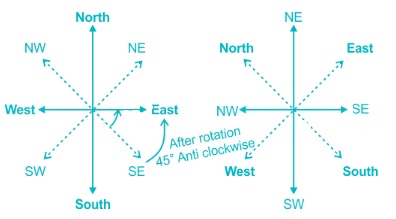
So North be called North west
Option: 3 is correct
Explanation:
- To solve the problem, start by determining what day today is if the day before yesterday was Tuesday.
- If the day before yesterday was Tuesday, then yesterday was Wednesday.
- Consequently, today must be Thursday.
- Now, calculate when Saturday will occur.
- If today is Thursday, then tomorrow is Friday.
- The day after tomorrow is Saturday.
- Option 1: Today – Incorrect. Today is Thursday, not Saturday.
- Option 2: Tomorrow – Incorrect. Tomorrow is Friday.
- Option 3: Day after tomorrow – Correct. Saturday will be the day after tomorrow.
- Option 4: Two days after tomorrow – Incorrect. That would be Sunday.
Option 3: Day after tomorrow is the correct answer.
Option: 1 is correct
Explanation:
9
Option: 1 is correct
Explanation:
- We know there are 64 children who like cricket.
- There are 53 children who enjoy football.
- Among them, 20 children enjoy both sports.
- To find those who like at least one of the sports, use the formula:
Total = Cricket + Football - Both
Total = 64 + 53 - 20 = 97
- This means 97 kids like either cricket or football or both.
- So, those not interested in either sport are 100 - 97 = 3.
Option:1, 3
The correct option is indeed 3.
Option: 4 is correct
Explanation:
- Two years ago, B was 7 years old (since B is currently 9 years old).
- At that time, A was three times B's age, making A 21 (3 times 7).
- Currently, A is 23 years old (21 + 2 years).
- The goal is to find when A's age will be double B's age.
- Suppose this occurs in x years. The equations are:
- A's future age = 23 + x
- B's future age = 9 + x
- The condition is: 23 + x = 2(9 + x).
- Solving:
- 23 + x = 18 + 2x
- 23 - 18 = 2x - x
- 5 = x
- After 5 years, A's age will be double B's age.
- Correct Answer: Option 4, 5 years.