Read the passage given below and then answer the questions given below the passage. Some words may be highlighted for your attention. Pay careful attention.
nce 2011, the world’s steelmakers have been feeling the heat. Prices for the metal have halved due to flatlining demand and rising exports from China, which now smelts 50% of the global output. Profits at steel firms around the world have fallen into a sea of red ink, shuttering plants and laying off workers. New measures designed to raise the price of carbon in the EU to help the bloc meet its climate-change targets, voted on by the European Parliament on February 15th, threaten to increase the pressure. The industry is a heavy user of carbon; responsible for 5% of global emissions. Some steel firms have responded by calling for carbon tariffs to prevent the measures undermining their international competitiveness. How do border taxes on carbon emissions work? And are they a good idea?
The reforms the European Parliament passed this week are an attempt to increase the price of carbon by cutting the emissions allowances granted to firms. The measures include the EU’s first border tax on carbon, levied on cement imports. Steel firms, also heavy users of carbon, say their exclusion from this scheme is unfair. This week Lakshmi Mittal, the CEO of Arcelor Mittal, the world’s biggest steelmaker, offered his support for the tax. Similar proposals in America are also being mooted. This month a group of Republicans—including two former treasury secretaries, James Baker and George Shultz—proposed a similar levy on imports at the border, as well as for domestic production. Their plan includes a carbon tax on imports of up to $40 for each tonne produced by their manufacture, which would increase over time. The income from the levy would then be distributed to American households on a quarterly basis to make up for higher consumer prices.
Proponents of such policies say that they remove the distortions caused by carbon taxes. Under the EU’s reforms, steelmakers in Europe would pay up to €30 ($32) to emit a tonne of carbon, but foreign producers selling in the EU would not have to pay a cent. This harms the cost competitiveness of European producers. It also encourages firms to move production outside the bloc rather than prompt them to use cleaner methods. Taxing imports on their embodied carbon—where this has not already happened in their country of origin—would level the playing field between different systems, they say. It would also give an incentive to countries without controls on emissions to introduce their own carbon taxes, in order to grab a share of the revenues
Economists say the idea works in theory. But many think it would be much more difficult in practice. One big problem is the difficulty of calculating the embodied carbon in imports. This is not easy even for simple sheets of steel; for items made of several bits of metal from different sources, it is hellishly complex. Disputes over this could produce reams of litigation at the WTO between various systems. But the reason why trade economists are so squeamish about carbon tariffs is the fear that they could cause a tariff war. The EU and America are already in a politically driven tit-for-tat over steel duties with China; they have risen in some cases to over 500%. Rather than prod countries to tighten their own regulations, new carbon tariffs could make that battle more vicious. Worse still, lobby groups could easily pervert the charges into a form of quiet protectionism. Donald Trump’s presidency has already rattled free-traders’ nerves. Why risk giving the protectionists another opening?
Question:
How can raising carbon prices affect the steel industry?
Raising carbon prices cannot affect the steel industry in anyway.
The steel industry is a heavy user of carbon and accounts for 5% of the global carbon emissions. Thus raising carbon prices will increase overall cost for the steel industry ultimately lowering their profit margin and cause further increase in already existing problems like closure of plants and laying off of workers.
The steel industry is a heavy user of carbon accounting for 5% of the global carbon emissions. Thus if it has to pay more fines, it will cut it from the salary of the workers causing worker unrest.
The proposed increase in price has been put forth by the European Union and it is to be implemented on the European steel industries. This would cause the European steel industry to lose out against the Chinese steel industry in the global market as China doesn't have extra taxes on them
. The steel industries are dying as the there is less requirement of steel in this plastic age and a further rise in carbon prices would provide a death knell as they would lose out on their minimum profit margin.
Read the passage given below and then answer the questions given below the passage. Some words may be highlighted for your attention. Pay careful attention.
nce 2011, the world’s steelmakers have been feeling the heat. Prices for the metal have halved due to flatlining demand and rising exports from China, which now smelts 50% of the global output. Profits at steel firms around the world have fallen into a sea of red ink, shuttering plants and laying off workers. New measures designed to raise the price of carbon in the EU to help the bloc meet its climate-change targets, voted on by the European Parliament on February 15th, threaten to increase the pressure. The industry is a heavy user of carbon; responsible for 5% of global emissions. Some steel firms have responded by calling for carbon tariffs to prevent the measures undermining their international competitiveness. How do border taxes on carbon emissions work? And are they a good idea?
The reforms the European Parliament passed this week are an attempt to increase the price of carbon by cutting the emissions allowances granted to firms. The measures include the EU’s first border tax on carbon, levied on cement imports. Steel firms, also heavy users of carbon, say their exclusion from this scheme is unfair. This week Lakshmi Mittal, the CEO of Arcelor Mittal, the world’s biggest steelmaker, offered his support for the tax. Similar proposals in America are also being mooted. This month a group of Republicans—including two former treasury secretaries, James Baker and George Shultz—proposed a similar levy on imports at the border, as well as for domestic production. Their plan includes a carbon tax on imports of up to $40 for each tonne produced by their manufacture, which would increase over time. The income from the levy would then be distributed to American households on a quarterly basis to make up for higher consumer prices.
Proponents of such policies say that they remove the distortions caused by carbon taxes. Under the EU’s reforms, steelmakers in Europe would pay up to €30 ($32) to emit a tonne of carbon, but foreign producers selling in the EU would not have to pay a cent. This harms the cost competitiveness of European producers. It also encourages firms to move production outside the bloc rather than prompt them to use cleaner methods. Taxing imports on their embodied carbon—where this has not already happened in their country of origin—would level the playing field between different systems, they say. It would also give an incentive to countries without controls on emissions to introduce their own carbon taxes, in order to grab a share of the revenues
Economists say the idea works in theory. But many think it would be much more difficult in practice. One big problem is the difficulty of calculating the embodied carbon in imports. This is not easy even for simple sheets of steel; for items made of several bits of metal from different sources, it is hellishly complex. Disputes over this could produce reams of litigation at the WTO between various systems. But the reason why trade economists are so squeamish about carbon tariffs is the fear that they could cause a tariff war. The EU and America are already in a politically driven tit-for-tat over steel duties with China; they have risen in some cases to over 500%. Rather than prod countries to tighten their own regulations, new carbon tariffs could make that battle more vicious. Worse still, lobby groups could easily pervert the charges into a form of quiet protectionism. Donald Trump’s presidency has already rattled free-traders’ nerves. Why risk giving the protectionists another opening?
Question:
Why do carbon taxes cause firms to move production outside the bloc?
Currently, carbon taxes are applicable on the firms that produce steel inside the European bloc's territory whereas any foreign producer selling to the bloc need not pay the taxes. This creates price disparity between the producers prompting many to produce outside the bloc and sell back to the bloc increasing their profit margin.
Currently, carbon taxes are applicable on the firms that produce steel inside the European bloc's territory and also outside the bloc's territory. Thus the firms are moving production outside the bloc as well as selling to escape the additional burden of the carbon taxes instead of moving to more cleaner practices of steel production.
Carbon taxes where put into play to control the emission of carbon by steel producing firms. But it has failed to create a level playing field for the firms as they are losing out against foreign competitors.
Carbon taxes are only applicable on firms producing inside the European territory. This lowers the profit margin of the firms and also forces them to adopt more cleaner methods of production. Thus it allows the lowering of carbon emission.
Carbon taxes are not causing firms to produce outside the bloc but the forced methods of cleaner steel production is prompting many firms to move production outside the bloc.
Read the passage given below and then answer the questions given below the passage. Some words may be highlighted for your attention. Pay careful attention.
nce 2011, the world’s steelmakers have been feeling the heat. Prices for the metal have halved due to flatlining demand and rising exports from China, which now smelts 50% of the global output. Profits at steel firms around the world have fallen into a sea of red ink, shuttering plants and laying off workers. New measures designed to raise the price of carbon in the EU to help the bloc meet its climate-change targets, voted on by the European Parliament on February 15th, threaten to increase the pressure. The industry is a heavy user of carbon; responsible for 5% of global emissions. Some steel firms have responded by calling for carbon tariffs to prevent the measures undermining their international competitiveness. How do border taxes on carbon emissions work? And are they a good idea?
The reforms the European Parliament passed this week are an attempt to increase the price of carbon by cutting the emissions allowances granted to firms. The measures include the EU’s first border tax on carbon, levied on cement imports. Steel firms, also heavy users of carbon, say their exclusion from this scheme is unfair. This week Lakshmi Mittal, the CEO of Arcelor Mittal, the world’s biggest steelmaker, offered his support for the tax. Similar proposals in America are also being mooted. This month a group of Republicans—including two former treasury secretaries, James Baker and George Shultz—proposed a similar levy on imports at the border, as well as for domestic production. Their plan includes a carbon tax on imports of up to $40 for each tonne produced by their manufacture, which would increase over time. The income from the levy would then be distributed to American households on a quarterly basis to make up for higher consumer prices.
Proponents of such policies say that they remove the distortions caused by carbon taxes. Under the EU’s reforms, steelmakers in Europe would pay up to €30 ($32) to emit a tonne of carbon, but foreign producers selling in the EU would not have to pay a cent. This harms the cost competitiveness of European producers. It also encourages firms to move production outside the bloc rather than prompt them to use cleaner methods. Taxing imports on their embodied carbon—where this has not already happened in their country of origin—would level the playing field between different systems, they say. It would also give an incentive to countries without controls on emissions to introduce their own carbon taxes, in order to grab a share of the revenues
Economists say the idea works in theory. But many think it would be much more difficult in practice. One big problem is the difficulty of calculating the embodied carbon in imports. This is not easy even for simple sheets of steel; for items made of several bits of metal from different sources, it is hellishly complex. Disputes over this could produce reams of litigation at the WTO between various systems. But the reason why trade economists are so squeamish about carbon tariffs is the fear that they could cause a tariff war. The EU and America are already in a politically driven tit-for-tat over steel duties with China; they have risen in some cases to over 500%. Rather than prod countries to tighten their own regulations, new carbon tariffs could make that battle more vicious. Worse still, lobby groups could easily pervert the charges into a form of quiet protectionism. Donald Trump’s presidency has already rattled free-traders’ nerves. Why risk giving the protectionists another opening?
Question:
'One big problem is the difficulty of calculating the embodied carbon in imports.' Which option can be called an inference from this sentence?
Carbon particles are omnipresent in all things and hence it is difficult to calculate their quantity for purpose of taxation.
Carbon particles are limited in their availability and hence are difficult to calculate
Carbon taxation is good only in theory.
carbon taxation is good in practice.
Carbon taxation should only be applied to firms producing within a certain territory.
Read the passage given below and then answer the questions given below the passage. Some words may be highlighted for your attention. Pay careful attention.
nce 2011, the world’s steelmakers have been feeling the heat. Prices for the metal have halved due to flatlining demand and rising exports from China, which now smelts 50% of the global output. Profits at steel firms around the world have fallen into a sea of red ink, shuttering plants and laying off workers. New measures designed to raise the price of carbon in the EU to help the bloc meet its climate-change targets, voted on by the European Parliament on February 15th, threaten to increase the pressure. The industry is a heavy user of carbon; responsible for 5% of global emissions. Some steel firms have responded by calling for carbon tariffs to prevent the measures undermining their international competitiveness. How do border taxes on carbon emissions work? And are they a good idea?
The reforms the European Parliament passed this week are an attempt to increase the price of carbon by cutting the emissions allowances granted to firms. The measures include the EU’s first border tax on carbon, levied on cement imports. Steel firms, also heavy users of carbon, say their exclusion from this scheme is unfair. This week Lakshmi Mittal, the CEO of Arcelor Mittal, the world’s biggest steelmaker, offered his support for the tax. Similar proposals in America are also being mooted. This month a group of Republicans—including two former treasury secretaries, James Baker and George Shultz—proposed a similar levy on imports at the border, as well as for domestic production. Their plan includes a carbon tax on imports of up to $40 for each tonne produced by their manufacture, which would increase over time. The income from the levy would then be distributed to American households on a quarterly basis to make up for higher consumer prices.
Proponents of such policies say that they remove the distortions caused by carbon taxes. Under the EU’s reforms, steelmakers in Europe would pay up to €30 ($32) to emit a tonne of carbon, but foreign producers selling in the EU would not have to pay a cent. This harms the cost competitiveness of European producers. It also encourages firms to move production outside the bloc rather than prompt them to use cleaner methods. Taxing imports on their embodied carbon—where this has not already happened in their country of origin—would level the playing field between different systems, they say. It would also give an incentive to countries without controls on emissions to introduce their own carbon taxes, in order to grab a share of the revenues
Economists say the idea works in theory. But many think it would be much more difficult in practice. One big problem is the difficulty of calculating the embodied carbon in imports. This is not easy even for simple sheets of steel; for items made of several bits of metal from different sources, it is hellishly complex. Disputes over this could produce reams of litigation at the WTO between various systems. But the reason why trade economists are so squeamish about carbon tariffs is the fear that they could cause a tariff war. The EU and America are already in a politically driven tit-for-tat over steel duties with China; they have risen in some cases to over 500%. Rather than prod countries to tighten their own regulations, new carbon tariffs could make that battle more vicious. Worse still, lobby groups could easily pervert the charges into a form of quiet protectionism. Donald Trump’s presidency has already rattled free-traders’ nerves. Why risk giving the protectionists another opening?
Question:
Which word correctly describes the author's opinion regarding protectionism?
Amused
Terrified
Jovial
Threatened
Sceptical
Read the passage given below and then answer the questions given below the passage. Some words may be highlighted for your attention. Pay careful attention.
nce 2011, the world’s steelmakers have been feeling the heat. Prices for the metal have halved due to flatlining demand and rising exports from China, which now smelts 50% of the global output. Profits at steel firms around the world have fallen into a sea of red ink, shuttering plants and laying off workers. New measures designed to raise the price of carbon in the EU to help the bloc meet its climate-change targets, voted on by the European Parliament on February 15th, threaten to increase the pressure. The industry is a heavy user of carbon; responsible for 5% of global emissions. Some steel firms have responded by calling for carbon tariffs to prevent the measures undermining their international competitiveness. How do border taxes on carbon emissions work? And are they a good idea?
The reforms the European Parliament passed this week are an attempt to increase the price of carbon by cutting the emissions allowances granted to firms. The measures include the EU’s first border tax on carbon, levied on cement imports. Steel firms, also heavy users of carbon, say their exclusion from this scheme is unfair. This week Lakshmi Mittal, the CEO of Arcelor Mittal, the world’s biggest steelmaker, offered his support for the tax. Similar proposals in America are also being mooted. This month a group of Republicans—including two former treasury secretaries, James Baker and George Shultz—proposed a similar levy on imports at the border, as well as for domestic production. Their plan includes a carbon tax on imports of up to $40 for each tonne produced by their manufacture, which would increase over time. The income from the levy would then be distributed to American households on a quarterly basis to make up for higher consumer prices.
Proponents of such policies say that they remove the distortions caused by carbon taxes. Under the EU’s reforms, steelmakers in Europe would pay up to €30 ($32) to emit a tonne of carbon, but foreign producers selling in the EU would not have to pay a cent. This harms the cost competitiveness of European producers. It also encourages firms to move production outside the bloc rather than prompt them to use cleaner methods. Taxing imports on their embodied carbon—where this has not already happened in their country of origin—would level the playing field between different systems, they say. It would also give an incentive to countries without controls on emissions to introduce their own carbon taxes, in order to grab a share of the revenues
Economists say the idea works in theory. But many think it would be much more difficult in practice. One big problem is the difficulty of calculating the embodied carbon in imports. This is not easy even for simple sheets of steel; for items made of several bits of metal from different sources, it is hellishly complex. Disputes over this could produce reams of litigation at the WTO between various systems. But the reason why trade economists are so squeamish about carbon tariffs is the fear that they could cause a tariff war. The EU and America are already in a politically driven tit-for-tat over steel duties with China; they have risen in some cases to over 500%. Rather than prod countries to tighten their own regulations, new carbon tariffs could make that battle more vicious. Worse still, lobby groups could easily pervert the charges into a form of quiet protectionism. Donald Trump’s presidency has already rattled free-traders’ nerves. Why risk giving the protectionists another opening?
Question:
From the given options choose the correct synonym for the word 'undermining' in context of the given passage.
Sabotage
Erode
Undercut
Hurt
Subvert
Read the passage given below and then answer the questions given below the passage. Some words may be highlighted for your attention. Pay careful attention.
nce 2011, the world’s steelmakers have been feeling the heat. Prices for the metal have halved due to flatlining demand and rising exports from China, which now smelts 50% of the global output. Profits at steel firms around the world have fallen into a sea of red ink, shuttering plants and laying off workers. New measures designed to raise the price of carbon in the EU to help the bloc meet its climate-change targets, voted on by the European Parliament on February 15th, threaten to increase the pressure. The industry is a heavy user of carbon; responsible for 5% of global emissions. Some steel firms have responded by calling for carbon tariffs to prevent the measures undermining their international competitiveness. How do border taxes on carbon emissions work? And are they a good idea?
The reforms the European Parliament passed this week are an attempt to increase the price of carbon by cutting the emissions allowances granted to firms. The measures include the EU’s first border tax on carbon, levied on cement imports. Steel firms, also heavy users of carbon, say their exclusion from this scheme is unfair. This week Lakshmi Mittal, the CEO of Arcelor Mittal, the world’s biggest steelmaker, offered his support for the tax. Similar proposals in America are also being mooted. This month a group of Republicans—including two former treasury secretaries, James Baker and George Shultz—proposed a similar levy on imports at the border, as well as for domestic production. Their plan includes a carbon tax on imports of up to $40 for each tonne produced by their manufacture, which would increase over time. The income from the levy would then be distributed to American households on a quarterly basis to make up for higher consumer prices.
Proponents of such policies say that they remove the distortions caused by carbon taxes. Under the EU’s reforms, steelmakers in Europe would pay up to €30 ($32) to emit a tonne of carbon, but foreign producers selling in the EU would not have to pay a cent. This harms the cost competitiveness of European producers. It also encourages firms to move production outside the bloc rather than prompt them to use cleaner methods. Taxing imports on their embodied carbon—where this has not already happened in their country of origin—would level the playing field between different systems, they say. It would also give an incentive to countries without controls on emissions to introduce their own carbon taxes, in order to grab a share of the revenues
Economists say the idea works in theory. But many think it would be much more difficult in practice. One big problem is the difficulty of calculating the embodied carbon in imports. This is not easy even for simple sheets of steel; for items made of several bits of metal from different sources, it is hellishly complex. Disputes over this could produce reams of litigation at the WTO between various systems. But the reason why trade economists are so squeamish about carbon tariffs is the fear that they could cause a tariff war. The EU and America are already in a politically driven tit-for-tat over steel duties with China; they have risen in some cases to over 500%. Rather than prod countries to tighten their own regulations, new carbon tariffs could make that battle more vicious. Worse still, lobby groups could easily pervert the charges into a form of quiet protectionism. Donald Trump’s presidency has already rattled free-traders’ nerves. Why risk giving the protectionists another opening?
Question:
From the given options choose the correct antonym for the word 'vicious' in context of the given passage.
Atrocious
Mild
Savage
Civilized
Good
Read the passage given below and then answer the questions given below the passage. Some words may be highlighted for your attention. Pay careful attention.
nce 2011, the world’s steelmakers have been feeling the heat. Prices for the metal have halved due to flatlining demand and rising exports from China, which now smelts 50% of the global output. Profits at steel firms around the world have fallen into a sea of red ink, shuttering plants and laying off workers. New measures designed to raise the price of carbon in the EU to help the bloc meet its climate-change targets, voted on by the European Parliament on February 15th, threaten to increase the pressure. The industry is a heavy user of carbon; responsible for 5% of global emissions. Some steel firms have responded by calling for carbon tariffs to prevent the measures undermining their international competitiveness. How do border taxes on carbon emissions work? And are they a good idea?
The reforms the European Parliament passed this week are an attempt to increase the price of carbon by cutting the emissions allowances granted to firms. The measures include the EU’s first border tax on carbon, levied on cement imports. Steel firms, also heavy users of carbon, say their exclusion from this scheme is unfair. This week Lakshmi Mittal, the CEO of Arcelor Mittal, the world’s biggest steelmaker, offered his support for the tax. Similar proposals in America are also being mooted. This month a group of Republicans—including two former treasury secretaries, James Baker and George Shultz—proposed a similar levy on imports at the border, as well as for domestic production. Their plan includes a carbon tax on imports of up to $40 for each tonne produced by their manufacture, which would increase over time. The income from the levy would then be distributed to American households on a quarterly basis to make up for higher consumer prices.
Proponents of such policies say that they remove the distortions caused by carbon taxes. Under the EU’s reforms, steelmakers in Europe would pay up to €30 ($32) to emit a tonne of carbon, but foreign producers selling in the EU would not have to pay a cent. This harms the cost competitiveness of European producers. It also encourages firms to move production outside the bloc rather than prompt them to use cleaner methods. Taxing imports on their embodied carbon—where this has not already happened in their country of origin—would level the playing field between different systems, they say. It would also give an incentive to countries without controls on emissions to introduce their own carbon taxes, in order to grab a share of the revenues
Economists say the idea works in theory. But many think it would be much more difficult in practice. One big problem is the difficulty of calculating the embodied carbon in imports. This is not easy even for simple sheets of steel; for items made of several bits of metal from different sources, it is hellishly complex. Disputes over this could produce reams of litigation at the WTO between various systems. But the reason why trade economists are so squeamish about carbon tariffs is the fear that they could cause a tariff war. The EU and America are already in a politically driven tit-for-tat over steel duties with China; they have risen in some cases to over 500%. Rather than prod countries to tighten their own regulations, new carbon tariffs could make that battle more vicious. Worse still, lobby groups could easily pervert the charges into a form of quiet protectionism. Donald Trump’s presidency has already rattled free-traders’ nerves. Why risk giving the protectionists another opening?
Question:
Whose presidency has rattled the free - traders' nerves?
Barrack Obama
Donald Trump
Vladimir Putin
Narendra Modi
Pranab Mukherjee
Directions: In a question given below an incomplete sentence that must be filled/ completed with one of the sentences/phrases given below i.e. one of the sentences/phrases can be fit into the given blanks. Choose the correct option and complete the given sentences.
Cyber physical systems _______________________________ due to the destruction of conventional jobs and the mechanization of jobs.
deals with training youth for new kinds of jobs that would have ben created
2. deal with training youth for new kinds of jobs that would be create
deal with train youth for new kinds of jobs that would be created
deals with training youth for new kinds of jobs that would be created
deal with training youth for new kinds of jobs that would be created
Directions: In a question given below an incomplete sentence that must be filled/ completed with one of the sentences/phrases given below i.e. one of the sentences/phrases can be fit into the given blanks. Choose the correct option and complete the given sentences.
Zero budget farming is a form of natural farming _______________________________.
which is neither chemical-loaded or organic with its reliance on manure.
which is neither chemical-loaded nor organic with its reliance on manure.
which is either chemical-loaded nor organic with its reliance on manure.
who is neither chemical-loaded nor organic with its reliance on manure.
which is neither chemical-loaded nor organic with it's reliance on manure.
In the following question, two columns are given containing three phrases each. In the first column phrases are A, B, and C and in the second column, the phrases are D, E, and F. A phrase from the first column may or may not connect with phrase from the second column to make grammatically and contextually correct sentence. There are five options, four of which display the sequence(s) in which the phrases can be joined to form a grammatically and contextually correct sentence. If none of the options forms a correct sentence after combination, select ‘None of these’ as your answer.
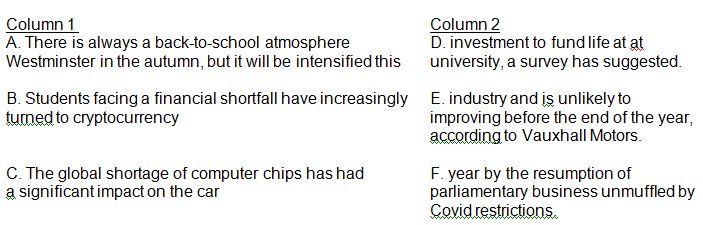
B - E, C - D
A - E, B - D, C - F
A - F, B - D
A - F, B - E, C - D
None of these
In the following question, two columns are given containing three phrases each. In the first column phrases are A, B, and C and in the second column, the phrases are D, E, and F. A phrase from the first column may or may not connect with phrase from the second column to make grammatically and contextually correct sentence. There are five options, four of which display the sequence(s) in which the phrases can be joined to form a grammatically and contextually correct sentence. If none of the options forms a correct sentence after combination, select ‘None of these’ as your answer.
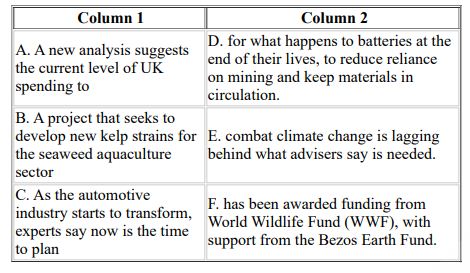
A-F, B-D, C-E
B-E, C-D
A-E, B-F, C-D
A-D, B-F
None of these
In the question below, three statements are given which may or may not be grammatically correct. Choose the sentence/sentences that is/are grammatically incorrect.
A. Venus is more nearer to Earth than Jupiter and so, appears brighter in the night sky; however, this alone does not account for its larger-than-life appearance.
B. The British fixation with the weather seems to link readily with a pessimistic view of Britain’s vulnerability to flooding.
C. In one of the most widely scrutinized CEO succession ever, Microsoft directors selected insider Satya Nadella to run the company.
B and C
A and B
A and C
Only B
Only A
In the question below, three statements are given which may or may not be grammatically correct. Choose the sentence/sentences that is/are grammatically incorrect.
A. I will have been working in this organization for eleven years next year.
B. Meanwhile, the gallant Jos had agreed to escort her sister and the major’s wife, the bulk whose goods and chattels, including the famous bird of paradise and the turban, was with the regimental baggage.
C. The manager wanted to know whether the problem was rectified.
Only A
Only C
A and B
A and C
B and C
Directions: Given below are 3 sentences, one or more of them is incorrect. Identify the one(s) that are incorrect.
(A) The council is encouraging the development of the property for both employment as well as recreation.
(B) Instead of simply punishing them, the system encourages offenders to modify their behaviour.
(C) The new teaching methods encourage children to think for themselves.
Only A
Only B
Only C
A and B
B and C
Directions: Given below are 3 sentences, one or more of them is incorrect. Identify the one(s) that are incorrect.
(A) She has been a stalwart supporter of the party for many years.
(B) He often extol the virtues of his students.
(C) Would all those in favour please raise their hands?
Only A
Only B
Only C
A and B
B and C
Directions: Given below are 3 sentences, one or more of them is incorrect. Identify the one(s) that are incorrect.
(A) Less profitable business operations will have difficulty in finding financial support.
(B) Did you get any sense of how they might react?
(C) It's important to distinguished between business and pleasure.
Only A
Only B
Only C
A and B
A and C
Arrange the following parts of a sentence in the correct order and mark the correct option.
A. remain indifferent B. stride forward
C. even if others
D. you should
E. to the humanitarian cause
CABED
BACED
DBCEA
ECBAD
CAEDB
Arrange the following parts of a sentence in the correct order and mark the correct option.
A. field of science
B. concerned with
C. robotics is the
D. and technology
E. creating robots
CAEBD
CADBE
CADEB
CBADE
ACDBE
The question below contains five scattered segments of a sentence. Indicate the sequence which correctly assembles the segments and completes the sentence.
A. 16.8% in May 2021, with six sectors reporting
B. from May 2020 when the country was
C. in the middle of a national lockdown
D. positive growth due to the base effects
E. output from India's eight core industries grew
EDCAB
ECBAD
EADBC
EADCB
DBACE
Direction: There are two blanks in the sentence given below. From the pair of words given in the options, choose the one that fits into the blanks most appropriately.
______ dedication or loyalty and excessive adoration or appreciation are some of the ______ used by the subordinates to get into the good books of their managers.
Aggressive, behaviour
Sincere, quality
Ostentatious, tactics
Controversial, deterrence
Comprehensive, innovation
Direction: There are two blanks in the sentence given below. From the pair of words given in the options, choose the one that fits into the blanks most appropriately.
Children are _______ and so the parents have to adopt a well-balanced approach towards their ______ on the psychological, emotional and physical aspects.
Fragile, upbringing
Robust, breeding
Competitive, upgrading
Aggressive, substitution
Adamant, abeyance
Direction: There are two blanks in the sentence given below. From the pair of words given in the options, choose the one that fits into the blanks most appropriately.
A good teacher always has a ______ for knowledge and tries to ______ the same in his/her students.
Delight, deplore
Thirst, instill
Aversion, fabricate
Need, abjure
Clarity, reform
Directions: The question below has two blanks, each blank indicating that something has been omitted. Choose the set of words for each blank that best fit the meaning of the sentence as a whole.
The mother-in-law ranted at her daughter-in-law about her _______ for eating and _______ to work
vibrant, able
charge, outlay
fondness, aversion
rare, unusual
exceptional, vivid
Directions: The question below has two blanks, each blank indicating that something has been omitted. Choose the set of words for each blank that best fit the meaning of the sentence as a whole.
Fresh food is so _______ that prices have _______.
crawled, abundant
poked, generous
darted, tolerable
surged, lavish
scarce, rocketed
Read the following sentences. The second and fifth sentences are fixed and are numbered 2 and 5 respectively. The remaining are labeled P, Q, R,S and T. Rearrange these five sentences to form a meaningful paragraph and choose the proper sequence from the given options.
P. Research demonstrates that the fossil is over one million years old, eclipsing the previous record of hippo in the UK by at least 300,000 years and filling an important gap in the British fossil record.
2. In a new study published in the Journal of Quaternary Science and co-authored with researchers from Royal Holloway, University of London, the tooth is identified as belonging to an extinct species of hippo called Hippopotamus antiquus, which ranged across Europe in warm periods during the Ice Age.
Q. Excavations at Westbury Cave in Somerset, led by University of Leicester PhD student Neil Adams, uncovered a million-year-old hippo tooth which shows the animal roamed Britain much earlier than previously thought.
R. Professor Danielle Schreve, co-author of the study, said that Hippos are not only fabulous animals to find but they also reveal evidence about past climates.
5. Scientists know remarkably little about the fauna, flora and environments in Britain between about 1.8 and 0.8 million years ago, a key period when early humans were beginning to occupy Europe.
S. It was much larger than the modern African hippo, weighing around 3 tonnes, and was even more reliant on aquatic habitats than its living relative.
T. But new research at Westbury Cave is helping to fill in this gap and it shows that during this interval there were periods warm and wet enough to allow hippos to migrate all the way from the Mediterranean to southern England.
Question:
Which of the following will be the first sentence after rearrangement?
T
S
R
Q
P
Read the following sentences. The second and fifth sentences are fixed and are numbered 2 and 5 respectively. The remaining are labeled P, Q, R,S and T. Rearrange these five sentences to form a meaningful paragraph and choose the proper sequence from the given options.
P. Research demonstrates that the fossil is over one million years old, eclipsing the previous record of hippo in the UK by at least 300,000 years and filling an important gap in the British fossil record.
2. In a new study published in the Journal of Quaternary Science and co-authored with researchers from Royal Holloway, University of London, the tooth is identified as belonging to an extinct species of hippo called Hippopotamus antiquus, which ranged across Europe in warm periods during the Ice Age.
Q. Excavations at Westbury Cave in Somerset, led by University of Leicester PhD student Neil Adams, uncovered a million-year-old hippo tooth which shows the animal roamed Britain much earlier than previously thought.
R. Professor Danielle Schreve, co-author of the study, said that Hippos are not only fabulous animals to find but they also reveal evidence about past climates.
5. Scientists know remarkably little about the fauna, flora and environments in Britain between about 1.8 and 0.8 million years ago, a key period when early humans were beginning to occupy Europe.
S. It was much larger than the modern African hippo, weighing around 3 tonnes, and was even more reliant on aquatic habitats than its living relative.
T. But new research at Westbury Cave is helping to fill in this gap and it shows that during this interval there were periods warm and wet enough to allow hippos to migrate all the way from the Mediterranean to southern England.
Question:
Which of the following will be the fourth sentence after rearrangement?
Q
P
S
R
T
Read the following sentences. The second and fifth sentences are fixed and are numbered 2 and 5 respectively. The remaining are labeled P, Q, R,S and T. Rearrange these five sentences to form a meaningful paragraph and choose the proper sequence from the given options.
P. Research demonstrates that the fossil is over one million years old, eclipsing the previous record of hippo in the UK by at least 300,000 years and filling an important gap in the British fossil record.
2. In a new study published in the Journal of Quaternary Science and co-authored with researchers from Royal Holloway, University of London, the tooth is identified as belonging to an extinct species of hippo called Hippopotamus antiquus, which ranged across Europe in warm periods during the Ice Age.
Q. Excavations at Westbury Cave in Somerset, led by University of Leicester PhD student Neil Adams, uncovered a million-year-old hippo tooth which shows the animal roamed Britain much earlier than previously thought.
R. Professor Danielle Schreve, co-author of the study, said that Hippos are not only fabulous animals to find but they also reveal evidence about past climates.
5. Scientists know remarkably little about the fauna, flora and environments in Britain between about 1.8 and 0.8 million years ago, a key period when early humans were beginning to occupy Europe.
S. It was much larger than the modern African hippo, weighing around 3 tonnes, and was even more reliant on aquatic habitats than its living relative.
T. But new research at Westbury Cave is helping to fill in this gap and it shows that during this interval there were periods warm and wet enough to allow hippos to migrate all the way from the Mediterranean to southern England.
Question:
Which of the following will be the sixth sentence after rearrangement?
R
Q
P
S
T
Read the following sentences. The second and fifth sentences are fixed and are numbered 2 and 5 respectively. The remaining are labeled P, Q, R,S and T. Rearrange these five sentences to form a meaningful paragraph and choose the proper sequence from the given options.
P. Research demonstrates that the fossil is over one million years old, eclipsing the previous record of hippo in the UK by at least 300,000 years and filling an important gap in the British fossil record.
2. In a new study published in the Journal of Quaternary Science and co-authored with researchers from Royal Holloway, University of London, the tooth is identified as belonging to an extinct species of hippo called Hippopotamus antiquus, which ranged across Europe in warm periods during the Ice Age.
Q. Excavations at Westbury Cave in Somerset, led by University of Leicester PhD student Neil Adams, uncovered a million-year-old hippo tooth which shows the animal roamed Britain much earlier than previously thought.
R. Professor Danielle Schreve, co-author of the study, said that Hippos are not only fabulous animals to find but they also reveal evidence about past climates.
5. Scientists know remarkably little about the fauna, flora and environments in Britain between about 1.8 and 0.8 million years ago, a key period when early humans were beginning to occupy Europe.
S. It was much larger than the modern African hippo, weighing around 3 tonnes, and was even more reliant on aquatic habitats than its living relative.
T. But new research at Westbury Cave is helping to fill in this gap and it shows that during this interval there were periods warm and wet enough to allow hippos to migrate all the way from the Mediterranean to southern England.
Question:
Which of the following will be the third sentence after rearrangement?
T
R
S
Q
P
Read the following sentences. The second and fifth sentences are fixed and are numbered 2 and 5 respectively. The remaining are labeled P, Q, R,S and T. Rearrange these five sentences to form a meaningful paragraph and choose the proper sequence from the given options.
P. Research demonstrates that the fossil is over one million years old, eclipsing the previous record of hippo in the UK by at least 300,000 years and filling an important gap in the British fossil record.
2. In a new study published in the Journal of Quaternary Science and co-authored with researchers from Royal Holloway, University of London, the tooth is identified as belonging to an extinct species of hippo called Hippopotamus antiquus, which ranged across Europe in warm periods during the Ice Age.
Q. Excavations at Westbury Cave in Somerset, led by University of Leicester PhD student Neil Adams, uncovered a million-year-old hippo tooth which shows the animal roamed Britain much earlier than previously thought.
R. Professor Danielle Schreve, co-author of the study, said that Hippos are not only fabulous animals to find but they also reveal evidence about past climates.
5. Scientists know remarkably little about the fauna, flora and environments in Britain between about 1.8 and 0.8 million years ago, a key period when early humans were beginning to occupy Europe.
S. It was much larger than the modern African hippo, weighing around 3 tonnes, and was even more reliant on aquatic habitats than its living relative.
T. But new research at Westbury Cave is helping to fill in this gap and it shows that during this interval there were periods warm and wet enough to allow hippos to migrate all the way from the Mediterranean to southern England.
Question:
Which of the following will be the last( seventh) sentence after rearrangement?
R
Q
T
P
S
Directions: The question below has two blanks, each blank indicating that something has been omitted. Choose the set of words for each blank that best fit the meaning of the sentence as a whole.
As a police officer, you must be _______ of the fact some individuals will try to hurt you during their _______ attempts.
cognizant, escape
abide, insensible
rescue, oblivious
elude, vigilant
evade, wary
In the given question, two equations numbered l and II are given. You have to solve both the equations and mark the appropriate answer.
I. 12x2 – 7x + 1 = 0
II. 20y2 – 9y + 1 = 0
x > y
x < y
x ≥ y
x ≤ y
x = y or no relationship could be established
In the given question, two equations numbered l and II are given. You have to solve both the equations and mark the appropriate answer.
I. 12x2 + 5x – 3 = 0
II. 12y2 – 17y + 6 = 0
x > y
x < y
x ≥ y
x ≤ y
x = y or no relationship could be established
In the given question, two equations numbered l and II are given. You have to solve both the equations and mark the appropriate answer.
I. x2 + 17x + 52 = 0
II. 6y2 + y – 40 = 0
x > y
x < y
x ≥ y
x ≤ y
x = y or no relationship could be established
In the given question, two equations numbered l and II are given. You have to solve both the equations and mark the appropriate answer
I. 2x2 + 11x + 12 = 0
II. 5y2 + 27y + 10 = 0
if x < y
if x > y
if x ≤ y
if x ≥ y
if x = y or no relation can be established
In the given question, two equations numbered l and II are given. You have to solve both the equations and mark the appropriate answer.
I. 12x2 − 8√5x + 5 = 0
II. 5y2 − 9y + 4 = 0
x > y
x < y
x ≥ y
x ≤ y
x = y or no relation can be obtained
What approximate value should come in the place of question mark (?) in the following question? 255.89 + (15.98)3 ÷ 16.09 = 2? × 64 ÷ 2
2
3
4
5
6
What approximate value should come in the place of question mark (?) in the following question?
? = {21.88 × 5.25 + 581.98 ÷ 1.9 + √575.86 × 4.95 ÷ 2.97} 1/2
21
17
31
19
29
What approximate value should come in the place of question mark (?) in the following question?
(4.28 × 4.98)% of (29.89 × 63.84) + 449.9 = 629.8 + ?
146
192
204
226
176
What approximate value should come in the place of question mark (?) in the following question?
(1011.94 ÷ 22.943) + (1127.88 ÷ 2.97) = 209.98 + 6.97 × ?
15
45
22
30
36
What approximate value should come in the place of question mark (?) in the following question?
4499.95 + 499.95 ÷ 24.95 – 919.92 = 17.91 × ?
150
120
100
200
180
What approximate value should come in the place of question mark (?) in the following question?
598.01 ÷ 22.93 + √143.94 = √? + 287.88 ÷ 15.89
200
350
600
500
400
Direction: Study the given pie chart carefully and answer the following questions accordingly. Given pie chart shows the percentage of people living in six different blocks of a society. Total number of people = 2000
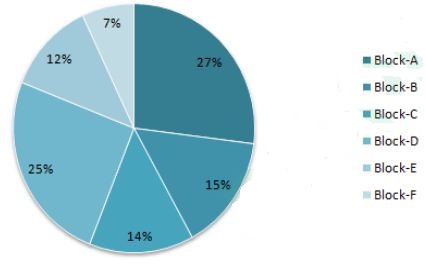
Question:
If 5/7th of the people who live in Block-C are female, then number of males living in Block-C is approximately what percentage of the total number of peoples who live Block-F?
57%
42%
63%
69%
51%
Direction: Study the given pie chart carefully and answer the following questions accordingly. Given pie chart shows the percentage of people living in six different blocks of a society. Total number of people = 2000
Question:
What is the difference between the total number of people who live in Block-A and Block-F together and the total number of people who live in Block-C and Block-E together?
146
156
180
160
None of these
Direction: Study the given pie chart carefully and answer the following questions accordingly. Given pie chart shows the percentage of people living in six different blocks of a society. Total number of people = 2000
Question:
If people living in Block-E is increased by 40% and percentage of people living in Block-A decreased by 20%, then what will be the total number of people living in Block-A and Block-E together?
634
768
658
778
None of these
Direction: Study the given pie chart carefully and answer the following questions accordingly. Given pie chart shows the percentage of people living in six different blocks of a society. Total number of people = 2000
Question:
Find the average of the total number of people living in block-A, block-B and block-E together?
400
360
450
380
270
Direction: Study the given pie chart carefully and answer the following questions accordingly. Given pie chart shows the percentage of people living in six different blocks of a society. Total number of people = 2000
Question:
What is the respective ratio of the number of people who live in Block-E and the number of people who live in Block-B?
6 : 7
4 : 7
3 : 5
4 : 5
None of these
Directions: Read the given table carefully and answer the following questions. The table shows the percentage number of males, females, and children travelers from different cities.
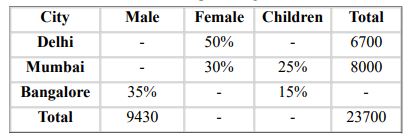
Question:
The Number of Male travelers from Delhi is approximately what percent of total male travelers from three cities?
20%
31%
23%
25%
28%
Directions: Read the given table carefully and answer the following questions. The table shows the percentage number of males, females, and children travelers from different cities.
Question:
Find the difference between the number of child travelers from Bangalore and Delhi.
1165
680
925
1015
818
Directions: Read the given table carefully and answer the following questions. The table shows the percentage number of males, females, and children travelers from different cities.
Question:
Find the ratio between male and female travelers from Bangalore.
5 : 7
7 : 10
7 : 4
3 : 8
4 : 3
Directions: Read the given table carefully and answer the following questions. The table shows the percentage number of males, females, and children travelers from different cities.
Question:
If 10% of female travelers are first-time travelers from three cities then the approximate average number of old female travelers of three cities are –
3480
3370
3460
3240
3075
Directions: Read the given table carefully and answer the following questions. The table shows the percentage number of males, females, and children travelers from different cities.
Question:
Approximately, the number of child travelers from all three cities is approximately what percent less than the number of Male travelers from all three cities?
69%
65%
57%
61%
50%
The Number of students in section A and B are 40 and 60 respectively. The average score in physics of students in section A is 35 and that of students in section A and B together is 50. What is the average score of the students of section B in physics?
55
45
60
50
None of these
The ratio of sale of mobile phones of a shop on Monday, Tuesday, Wednesday and Thursday is 5 : 4 : 8 : 3. The sale on Wednesday was 160. Find the number of mobile phones sold on Friday if the sale of Friday is 20% more than Monday
30
60
100
120
240
Ram spends 30% of his monthly income on food and 50% of the remaining on household expenses and saves the remaining Rs. 10,500. Find the monthly income of Shyam if monthly income of Ram is 25% less than that of Shyam.
Rs. 32,000
Rs. 35,000
Rs. 40,000
Rs. 38,000
Rs. 28,000
Rakesh's and Shanu's present ages are in the ratio 5: X. Shailu is 9 years older than Rakesh. Shailu will be 33 years of age after 9 years. The difference between the ages of Shanu and Rakesh is the same as Shailu's present age. What should be the value of X?
15
20
13
17
14
The difference between compound interest and simple interest for a certain amount of the sum for 2 years at the rate of 25 % is Rs. 25. Find the value of the principal and the ratio of compound interest to simple interest.
400, 9/8
200, 9/8
400, 11/10
200, 11/10
None of these
A and B together can complete a piece of work in 40 days, B and C can do it in 60 days and C and A can do it in 30 days. A, B, and C together can complete half of the actual work in
49/3 days
10/3 days
40/3 days
20/3 days
70/3 days
A 20 litres solution containing milk and water in the ratio 2 : 3 is mixed with 18 litres of 5 : 4 water and milk solution. What is the ratio of milk and water in the resultant mixture?
16 : 24
24 : 16
8 : 11
11 : 8
None of these
A man is running 400 m ahead of an engine of length 100m with a speed of 5 m/s. If the speed of the train in the same direction is 25 m/s, find in how much time the train will cross the man?
25 sec
22 sec
30 sec
35 sec
None of these
Anil, Aman, and Ankur entered into the garment business. Anil invests 2 times the amount as invested by Aman and Aman invests 3 times the amount as invested by Ankur. At the end of the year, the profit earned is Rs. 1,00,000. Find the share of each partner.
Rs. 60,000; Rs. 30,000 and Rs. 10,000
Rs. 50,000; Rs. 25,000 and Rs. 25,000
Rs. 75,000; Rs. 12,500 and Rs. 12,500
Rs. 80,000; Rs. 10,000 and Rs. 10,000
Rs. 60,000; Rs. 20,000 and Rs. 20,000
In a boutique, a girl prepared a dress for Rs. 3200 and marked it by 50% and she gave a discount of 20%. A customer came to her and bargained with her for more discount of 20% on the already discounted dress. Then what is the profit/loss earned by the girl?
Rs. 556
Rs. 156
Rs. 128
Rs. 132
Rs. 126
he speed of a power boat in still water is 144 km/hr and the speed of a stream is 54 km/hr. If Boat takes 0.2 hours more in upstream than to go downstream for the same distance, then find the distance travelled by boat in one directional way
33 km
22 km
44 km
55 km
None of these
The radius of the circle is 13 cm more than the breadth of a rectangle. The area of the circle is 3850 sq.cm. The circumference of the circle is equal to the perimeter of a rectangle. The area of the rectangle is equal to the area of a square. Find the perimeter of a square.
352 cm
164 cm
176 cm
188 cm
196 cm
A urn contains 7 blue pens & 6 red pens . 3 pens are drawn at random & then find the probability that 2 pens are blue & 1 pen is red.
63/143
7/143
6/143
7/189
71/143
15 taps are fitted in a tank in which some are inlet taps and some are outlet taps. Each inlet tap can fill the tank in 30 hours and each outlet tap can empty the tank in 60 hours. Find the number of inlet taps if the whole tank is filled in 4 hours when all the 15 taps are open.
12
13
10
11
9
If in a certain code language BEAUTIFUL is coded as MVGJUVBFC, then how PHENOMENON will be coded in the same code language?
OPOFSPOFIQ
OPOFNPOFIQ
OPOXNPOFIQ
OPOFNPLFIQ
OPOFNQOFIQ
Two friends A and B are playing in a park. After some time, A went to his home and B went to his office. A walked 8m towards North from the park and turned right and walked for 8m then took a right turn and walked for 8m to reach the mall then started walking in the north-east direction and covered a distance of 13m then started walking in the South direction and covered a distance of 12m to reach the Bus stand and finally turned left and walked for 6m to reach home. B walked 2m towards the east from the park and turned left and walked 6 m then turned right and walked 2 m. He then turned right and walked 9m and turned left and walked 2 m and again turned right and walked 2 m and finally turned left and walked 2 m to reach office.
Question:
What is the total distance covered by A from the park to the mall?
20 m
24 m
19 m
16 m
5. 12 m
Two friends A and B are playing in a park. After some time, A went to his home and B went to his office. A walked 8m towards North from the park and turned right and walked for 8m then took a right turn and walked for 8m to reach the mall then started walking in the north-east direction and covered a distance of 13m then started walking in the South direction and covered a distance of 12m to reach the Bus stand and finally turned left and walked for 6m to reach home. B walked 2m towards the east from the park and turned left and walked 6 m then turned right and walked 2 m. He then turned right and walked 9m and turned left and walked 2 m and again turned right and walked 2 m and finally turned left and walked 2 m to reach office.
Question:
What is the shortest distance between the mall and the bus stand?
5 m
25 m
6 m
7 m
9 m
Two friends A and B are playing in a park. After some time, A went to his home and B went to his office. A walked 8m towards North from the park and turned right and walked for 8m then took a right turn and walked for 8m to reach the mall then started walking in the north-east direction and covered a distance of 13m then started walking in the South direction and covered a distance of 12m to reach the Bus stand and finally turned left and walked for 6m to reach home. B walked 2m towards the east from the park and turned left and walked 6 m then turned right and walked 2 m. He then turned right and walked 9m and turned left and walked 2 m and again turned right and walked 2 m and finally turned left and walked 2 m to reach office.
Question:
In which direction is B's office with respect to B's initial position?
South-East
South-West
South
North
West
Direction: Read the following information carefully and answer the questions given below:
There are eight people: Ashu, Dishu, Krishu, Mishu, Nishu, Rishu, Prishu, and Vishu. They all were born in different years viz. 1973, 2001, 1985, 1979, 2004, 1989, 1995, and 1998 but not necessarily in the same order. But the date and month of birth of all these persons are the same. The calculation is done with respect to the present year 2021 and assuming months and date to the same.
The age of Mishu is a prime number. Two people were born between Mishu and Nishu. Two were born between Rishu and Ashu. The difference between the age of Nishu and Prishu is 6years. The age of Prishu is not divisible by 8. The age of Krishu is divisible by 4 but he is neither the eldest person nor was born adjacent to Nishu. Rishu was born just after Krishu. Dishu was born just before Ashu.
Question:
Who was born on 1985?
Krishu
Nishu
Ashu
Dishu
Rishu
Direction: Read the following information carefully and answer the questions given below:
There are eight people: Ashu, Dishu, Krishu, Mishu, Nishu, Rishu, Prishu, and Vishu. They all were born in different years viz. 1973, 2001, 1985, 1979, 2004, 1989, 1995, and 1998 but not necessarily in the same order. But the date and month of birth of all these persons are the same. The calculation is done with respect to the present year 2021 and assuming months and date to the same.
The age of Mishu is a prime number. Two people were born between Mishu and Nishu. Two were born between Rishu and Ashu. The difference between the age of Nishu and Prishu is 6years. The age of Prishu is not divisible by 8. The age of Krishu is divisible by 4 but he is neither the eldest person nor was born adjacent to Nishu. Rishu was born just after Krishu. Dishu was born just before Ashu.
Question:
Whose age is equal to the average age of Mishu and Rishu?
Prishu
Nishu
Ashu
Krishu
Vishu
Direction: Read the following information carefully and answer the questions given below:
There are eight people: Ashu, Dishu, Krishu, Mishu, Nishu, Rishu, Prishu, and Vishu. They all were born in different years viz. 1973, 2001, 1985, 1979, 2004, 1989, 1995, and 1998 but not necessarily in the same order. But the date and month of birth of all these persons are the same. The calculation is done with respect to the present year 2021 and assuming months and date to the same.
The age of Mishu is a prime number. Two people were born between Mishu and Nishu. Two were born between Rishu and Ashu. The difference between the age of Nishu and Prishu is 6years. The age of Prishu is not divisible by 8. The age of Krishu is divisible by 4 but he is neither the eldest person nor was born adjacent to Nishu. Rishu was born just after Krishu. Dishu was born just before Ashu.
Question:
How many people are born between Vishu and Dishu?
Two
Six
Four
One
None of these
Direction: Read the following information carefully and answer the questions given below:
There are eight people: Ashu, Dishu, Krishu, Mishu, Nishu, Rishu, Prishu, and Vishu. They all were born in different years viz. 1973, 2001, 1985, 1979, 2004, 1989, 1995, and 1998 but not necessarily in the same order. But the date and month of birth of all these persons are the same. The calculation is done with respect to the present year 2021 and assuming months and date to the same.
The age of Mishu is a prime number. Two people were born between Mishu and Nishu. Two were born between Rishu and Ashu. The difference between the age of Nishu and Prishu is 6years. The age of Prishu is not divisible by 8. The age of Krishu is divisible by 4 but he is neither the eldest person nor was born adjacent to Nishu. Rishu was born just after Krishu. Dishu was born just before Ashu.
Question:
Whose age is a multiple of 5?
Prishu
Nishu
Mishu
Ashu
Krishu
Direction: Read the following information carefully and answer the questions given below:
There are eight people: Ashu, Dishu, Krishu, Mishu, Nishu, Rishu, Prishu, and Vishu. They all were born in different years viz. 1973, 2001, 1985, 1979, 2004, 1989, 1995, and 1998 but not necessarily in the same order. But the date and month of birth of all these persons are the same. The calculation is done with respect to the present year 2021 and assuming months and date to the same.
The age of Mishu is a prime number. Two people were born between Mishu and Nishu. Two were born between Rishu and Ashu. The difference between the age of Nishu and Prishu is 6years. The age of Prishu is not divisible by 8. The age of Krishu is divisible by 4 but he is neither the eldest person nor was born adjacent to Nishu. Rishu was born just after Krishu. Dishu was born just before Ashu.
Question:
How many people are born between Vishu and Ashu?
Two
Four
Three
One
Five
Direction: Read the given information carefully and answer the questions asked below.
A certain number of persons sit in a linear row facing towards North. Five persons are sitting between Neha and Ritu. Riya sits fourth to the right of Ritu and third to the left of Megha. Number of persons sit between Neha and Priya is equal to the number of persons sit between Priya and Riya. Neha sits fourth from one of the extreme ends. Number of persons sits between Neha and Anu is one more than the persons sit between Anu and Priya. Nitu sits seventh to the left of Priya. As many persons sit to the right of Megha is one less than the total number of persons sit to the left of Nitu. Total number of persons are sitting between Neha and Riya is more than four.
Question:
How many persons sit to the left of Nitu?
One
Two
Three
Four
Five
Direction: Read the given information carefully and answer the questions asked below.
A certain number of persons sit in a linear row facing towards North. Five persons are sitting between Neha and Ritu. Riya sits fourth to the right of Ritu and third to the left of Megha. Number of persons sit between Neha and Priya is equal to the number of persons sit between Priya and Riya. Neha sits fourth from one of the extreme ends. Number of persons sits between Neha and Anu is one more than the persons sit between Anu and Priya. Nitu sits seventh to the left of Priya. As many persons sit to the right of Megha is one less than the total number of persons sit to the left of Nitu. Total number of persons are sitting between Neha and Riya is more than four.
Question:
Who sits extreme right end of the row?
Megha
Riya
Ritu
Neha
Priya
Direction: Read the given information carefully and answer the questions asked below.
A certain number of persons sit in a linear row facing towards North. Five persons are sitting between Neha and Ritu. Riya sits fourth to the right of Ritu and third to the left of Megha. Number of persons sit between Neha and Priya is equal to the number of persons sit between Priya and Riya. Neha sits fourth from one of the extreme ends. Number of persons sits between Neha and Anu is one more than the persons sit between Anu and Priya. Nitu sits seventh to the left of Priya. As many persons sit to the right of Megha is one less than the total number of persons sit to the left of Nitu. Total number of persons are sitting between Neha and Riya is more than four.
Question:
How many persons are sitting between Neha and Riya?
Six
Seven
Eight
Nine
Ten
Direction: Read the given information carefully and answer the questions asked below.
A certain number of persons sit in a linear row facing towards North. Five persons are sitting between Neha and Ritu. Riya sits fourth to the right of Ritu and third to the left of Megha. Number of persons sit between Neha and Priya is equal to the number of persons sit between Priya and Riya. Neha sits fourth from one of the extreme ends. Number of persons sits between Neha and Anu is one more than the persons sit between Anu and Priya. Nitu sits seventh to the left of Priya. As many persons sit to the right of Megha is one less than the total number of persons sit to the left of Nitu. Total number of persons are sitting between Neha and Riya is more than four.
Question:
Who sits fourth to the left of Riya?
Ritu
Neha
Megha
Priya
Riya
Direction: Read the given information carefully and answer the questions asked below.
A certain number of persons sit in a linear row facing towards North. Five persons are sitting between Neha and Ritu. Riya sits fourth to the right of Ritu and third to the left of Megha. Number of persons sit between Neha and Priya is equal to the number of persons sit between Priya and Riya. Neha sits fourth from one of the extreme ends. Number of persons sits between Neha and Anu is one more than the persons sit between Anu and Priya. Nitu sits seventh to the left of Priya. As many persons sit to the right of Megha is one less than the total number of persons sit to the left of Nitu. Total number of persons are sitting between Neha and Riya is more than four.
Question:
How many persons are sitting in a row?
15
16
17
10
12
Direction: Study the following information to answer the given questions:
Eight persons A, B, C, D, E, F, G and H are sitting in a horizontal row. Four of them face north while rest face south. Not more than two adjacent persons face in the same direction. A sits second to the left of D. F sits to the immediate left of H. D and F are adjacent to each other. C is not adjacent to A but faces south. The number of persons to the left of A is one more than the number of persons to the right of him. B sits second to the left of G and both face in the same direction. C does not sit at extreme end. The person at extreme end face in the same direction.
Question:
Who sits immediate right of C?
G
B
A
E
F
Direction: Study the following information to answer the given questions:
Eight persons A, B, C, D, E, F, G and H are sitting in a horizontal row. Four of them face north while rest face south. Not more than two adjacent persons face in the same direction. A sits second to the left of D. F sits to the immediate left of H. D and F are adjacent to each other. C is not adjacent to A but faces south. The number of persons to the left of A is one more than the number of persons to the right of him. B sits second to the left of G and both face in the same direction. C does not sit at extreme end. The person at extreme end face in the same direction.
Question:
Four are the same in a certain way thus forms a group. Which among the following does not belong to the group?
B
H
D
G
A
Direction: Study the following information to answer the given questions:
Eight persons A, B, C, D, E, F, G and H are sitting in a horizontal row. Four of them face north while rest face south. Not more than two adjacent persons face in the same direction. A sits second to the left of D. F sits to the immediate left of H. D and F are adjacent to each other. C is not adjacent to A but faces south. The number of persons to the left of A is one more than the number of persons to the right of him. B sits second to the left of G and both face in the same direction. C does not sit at extreme end. The person at extreme end face in the same direction.
Question:
How many persons sit to the right of E?
Three
Four
One
Five
Six
Direction: Study the following information to answer the given questions:
Eight persons A, B, C, D, E, F, G and H are sitting in a horizontal row. Four of them face north while rest face south. Not more than two adjacent persons face in the same direction. A sits second to the left of D. F sits to the immediate left of H. D and F are adjacent to each other. C is not adjacent to A but faces south. The number of persons to the left of A is one more than the number of persons to the right of him. B sits second to the left of G and both face in the same direction. C does not sit at extreme end. The person at extreme end face in the same direction.
Question:
Who sits second to the right of G?
E
D
F
H
C
Direction: Study the following information to answer the given questions:
Eight persons A, B, C, D, E, F, G and H are sitting in a horizontal row. Four of them face north while rest face south. Not more than two adjacent persons face in the same direction. A sits second to the left of D. F sits to the immediate left of H. D and F are adjacent to each other. C is not adjacent to A but faces south. The number of persons to the left of A is one more than the number of persons to the right of him. B sits second to the left of G and both face in the same direction. C does not sit at extreme end. The person at extreme end face in the same direction.
Question:
Who sits immediate left of G
B
C
D
F
H
Direction: Read the following information carefully and answer the questions that follow:
There are seven persons – P, Q, R, S, T, U and Vmoved to Delhi on different days of a week starting from Monday to Sunday not necessarily in same order. Each of them used different types of vehicles among Aeroplane, Autorickshaw, Bike, Bus, Car, Train and Truck(not necessarily in same order).
The one, who travelled by Train, moved just before the one, who travelled by Autorickshaw. Q, who travelled by Bus, moved just before R, who travelled by Aeroplane. V does not travel by Car. P travelled by Truck two days before the one, who travelled by car. P does not travel by Train or Bike. U moved on Sunday. At most two persons moved before P. Q does not move on Thursday. T moved before S, who moved before V.
Question:
Who among the following moved on Monday?
The one, who travelled by Aeroplane
T
M
Q
None of the above
Direction: Read the following information carefully and answer the questions that follow:
There are seven persons – P, Q, R, S, T, U and Vmoved to Delhi on different days of a week starting from Monday to Sunday not necessarily in same order. Each of them used different types of vehicles among Aeroplane, Autorickshaw, Bike, Bus, Car, Train and Truck(not necessarily in same order).
The one, who travelled by Train, moved just before the one, who travelled by Autorickshaw. Q, who travelled by Bus, moved just before R, who travelled by Aeroplane. V does not travel by Car. P travelled by Truck two days before the one, who travelled by car. P does not travel by Train or Bike. U moved on Sunday. At most two persons moved before P. Q does not move on Thursday. T moved before S, who moved before V.
Question:
How many persons moved before the one, who travelled by Bike?
Two
Four
Five
Six
Three
Direction: Read the following information carefully and answer the questions that follow:
There are seven persons – P, Q, R, S, T, U and Vmoved to Delhi on different days of a week starting from Monday to Sunday not necessarily in same order. Each of them used different types of vehicles among Aeroplane, Autorickshaw, Bike, Bus, Car, Train and Truck(not necessarily in same order).
The one, who travelled by Train, moved just before the one, who travelled by Autorickshaw. Q, who travelled by Bus, moved just before R, who travelled by Aeroplane. V does not travel by Car. P travelled by Truck two days before the one, who travelled by car. P does not travel by Train or Bike. U moved on Sunday. At most two persons moved before P. Q does not move on Thursday. T moved before S, who moved before V.
Question:
On which day does S move to Delhi?
Saturday
Friday
Tuesday
Sunday
None of the above
Direction: Read the following information carefully and answer the questions that follow:
There are seven persons – P, Q, R, S, T, U and Vmoved to Delhi on different days of a week starting from Monday to Sunday not necessarily in same order. Each of them used different types of vehicles among Aeroplane, Autorickshaw, Bike, Bus, Car, Train and Truck(not necessarily in same order).
The one, who travelled by Train, moved just before the one, who travelled by Autorickshaw. Q, who travelled by Bus, moved just before R, who travelled by Aeroplane. V does not travel by Car. P travelled by Truck two days before the one, who travelled by car. P does not travel by Train or Bike. U moved on Sunday. At most two persons moved before P. Q does not move on Thursday. T moved before S, who moved before V.
Question:
Which of the following pair is correct?
P, Bus
Saturday, R
Bike, T
U, Truck
Tuesday, V
Direction: Read the following information carefully and answer the questions that follow:
There are seven persons – P, Q, R, S, T, U and Vmoved to Delhi on different days of a week starting from Monday to Sunday not necessarily in same order. Each of them used different types of vehicles among Aeroplane, Autorickshaw, Bike, Bus, Car, Train and Truck(not necessarily in same order).
The one, who travelled by Train, moved just before the one, who travelled by Autorickshaw. Q, who travelled by Bus, moved just before R, who travelled by Aeroplane. V does not travel by Car. P travelled by Truck two days before the one, who travelled by car. P does not travel by Train or Bike. U moved on Sunday. At most two persons moved before P. Q does not move on Thursday. T moved before S, who moved before V.
Question:
How many persons moved after P?
Three
Four
Five
One
Two
Direction: Read the following information carefully and answer the question given below.
Ten people Aman, Sonam, Salvi, Sajida, Mahesh, Janvi, Manvi, Krishna, Sahil and Vishal are living on five different floors of a building. Ground floor is as 1st floor and top floor is as 5th floor. There are two flats on each floor. Flat-1 and Flat-2 from west to east such that Flat-2 is in east of Flat-1. Flat-1 of second floor is exactly above Flat-1 of first floor and other flats are placed in the same way.
Sahil lives just below the floor in which Vishal lives. More than two floors gap are between Sonam and Manvi. Both Krishna and Manvi live in the same floor. Mahesh lives on 2nd floor. There are two floors gap is between Mahesh and Vishal and both does not live in the same flat number. Aman lives just above the floor in which Sajida lives and in North-east with respect to Manvi. Janvi lives in west with respect to Sahil. Both Salvi and Sajida does not live in the same flat number.
Question:
Salvi lives west of whom?
Vishal
Krishna
Aman
Sahil
Sajida
Direction: Read the following information carefully and answer the question given below.
Ten people Aman, Sonam, Salvi, Sajida, Mahesh, Janvi, Manvi, Krishna, Sahil and Vishal are living on five different floors of a building. Ground floor is as 1st floor and top floor is as 5th floor. There are two flats on each floor. Flat-1 and Flat-2 from west to east such that Flat-2 is in east of Flat-1. Flat-1 of second floor is exactly above Flat-1 of first floor and other flats are placed in the same way.
Sahil lives just below the floor in which Vishal lives. More than two floors gap are between Sonam and Manvi. Both Krishna and Manvi live in the same floor. Mahesh lives on 2nd floor. There are two floors gap is between Mahesh and Vishal and both does not live in the same flat number. Aman lives just above the floor in which Sajida lives and in North-east with respect to Manvi. Janvi lives in west with respect to Sahil. Both Salvi and Sajida does not live in the same flat number.
Question:
How many floors are between Vishal and Krishna?
Two
Three
One
Zero
None
Direction: Read the following information carefully and answer the question given below.
Ten people Aman, Sonam, Salvi, Sajida, Mahesh, Janvi, Manvi, Krishna, Sahil and Vishal are living on five different floors of a building. Ground floor is as 1st floor and top floor is as 5th floor. There are two flats on each floor. Flat-1 and Flat-2 from west to east such that Flat-2 is in east of Flat-1. Flat-1 of second floor is exactly above Flat-1 of first floor and other flats are placed in the same way.
Sahil lives just below the floor in which Vishal lives. More than two floors gap are between Sonam and Manvi. Both Krishna and Manvi live in the same floor. Mahesh lives on 2nd floor. There are two floors gap is between Mahesh and Vishal and both does not live in the same flat number. Aman lives just above the floor in which Sajida lives and in North-east with respect to Manvi. Janvi lives in west with respect to Sahil. Both Salvi and Sajida does not live in the same flat number.
Question:
Which of the following combination is true?
Floor 3 - Flat 1 - Aman
Floor 2 - Flat 2 - Mahesh
Floor 1 - Flat 2 - Sajida
Floor 4 - Flat 1 - Salvi
Floor 5 - Flat 2 - Vishal
Direction: Read the following information carefully and answer the question given below.
Ten people Aman, Sonam, Salvi, Sajida, Mahesh, Janvi, Manvi, Krishna, Sahil and Vishal are living on five different floors of a building. Ground floor is as 1st floor and top floor is as 5th floor. There are two flats on each floor. Flat-1 and Flat-2 from west to east such that Flat-2 is in east of Flat-1. Flat-1 of second floor is exactly above Flat-1 of first floor and other flats are placed in the same way.
Sahil lives just below the floor in which Vishal lives. More than two floors gap are between Sonam and Manvi. Both Krishna and Manvi live in the same floor. Mahesh lives on 2nd floor. There are two floors gap is between Mahesh and Vishal and both does not live in the same flat number. Aman lives just above the floor in which Sajida lives and in North-east with respect to Manvi. Janvi lives in west with respect to Sahil. Both Salvi and Sajida does not live in the same flat number.
Question:
Who lives on floor 4?
Salvi - Aman
Mahesh - Sajida
Krishna - Manvi
Janvi - Sahil
Vishal - Sonam
Direction: Read the following information carefully and answer the question given below.
Ten people Aman, Sonam, Salvi, Sajida, Mahesh, Janvi, Manvi, Krishna, Sahil and Vishal are living on five different floors of a building. Ground floor is as 1st floor and top floor is as 5th floor. There are two flats on each floor. Flat-1 and Flat-2 from west to east such that Flat-2 is in east of Flat-1. Flat-1 of second floor is exactly above Flat-1 of first floor and other flats are placed in the same way.
Sahil lives just below the floor in which Vishal lives. More than two floors gap are between Sonam and Manvi. Both Krishna and Manvi live in the same floor. Mahesh lives on 2nd floor. There are two floors gap is between Mahesh and Vishal and both does not live in the same flat number. Aman lives just above the floor in which Sajida lives and in North-east with respect to Manvi. Janvi lives in west with respect to Sahil. Both Salvi and Sajida does not live in the same flat number.
Question:
Find odd one out.
Sajida
Manvi
Krishna
Salvi
Aman
Direction: Read the given statements and conclusions carefully. Assuming that the information given in the statements is true, even if it appears to be at variance with commonly known facts, decide which of the given conclusions logically follow(s) from the statements.
Statements:
I. All M are N.
II. Some M are P.
Conclusions:
I. Some P are N.
II. No P is a N.
Only Conclusion I follows
Only Conclusion II follows
Both conclusion I and II follows
None of the conclusion follows
Answer not known
In each question below are given some statements followed by some conclusions. You have to take the given statements to be true even if they seem to be at variance with commonly known facts and then decide which of the given conclusions logically follows from the given statements, disregarding commonly known facts. Give answer
Statements:
Only a few Red are Blue.
Only a few Blue is Pink. All Pink is Yellow.
Conclusions:
I. All Yellow being Blue is a possibility.
II. Some Pink is Red.
If only conclusion I follows.
If only conclusion II follows.
If either conclusion I or II follows.
If neither conclusion I nor II follows.
If both conclusions I and II follow.
Direction: In the question below are given two statements followed by two conclusions numbered I, and II. You have to take the given statements to be true even if they seem to be at variance with commonly known facts. Read all the conclusions and then decide which of the given conclusions logically follows from the given statements disregarding commonly known facts.
Statement:
Only a few Sea are River
All River are Water bodies
Conclusion :
I. Some Sea are Water bodies
II. All sea are River
Both I and II follows
Neither I and II follows
Either I or II follows
Only I follow
Only II follows
Direction: In the following question assuming the given statements to be true, find which of the conclusion among given some conclusion is/are definitely true and then give your answers accordingly
: Statement: C < R < I ≤ T ≤ S = Y > P ≥ A < L < D < F ≥ G ≥ H
Conclusions:
I. Y > C
II. Y > D
III. I < A
Only Conclusion I is True
Only Conclusion II is True
Only Conclusion III is True
Both Conclusion I and II is True
5. Both Conclusion I and IIi is True
Which of the following symbols should be placed in the blank spaces respectively (in the same order from left to right) in order to complete the given expression in such a manner that “S < X” and “N ≥ P” definitely hold True?
X _ N _ O ≥ S _ P
>, =, >
=, ≥, =
>, ≥, =
>, >, ≥
None of these
Which of the following symbols should replace '?' in the given expression in order to make expression P > Q definitely true?
R = N > Q ? T < V = O ? P ≥ S ≤ U
<, <
>, <
<, ≥
>, ≥
≥, ≥